There is a particular feeling I get in certain rooms. Not decorated rooms — the other kind. Rooms where the wood has carved symbols in it that someone chose because they meant something. Where the antlers on the wall are not ironic. Where the paintings are of fairies in forest clearings because whoever hung them believed, at least a little, that the forest had something in it worth believing in. Where the tartan throw on the sofa has a pattern that connects it to a specific place and a specific people and a specific set of hills that someone in the family line walked across before any of us were born.
Celtic home decor draws inspiration from the rich cultural heritage of the Celtic people — primarily from Ireland, Scotland, and Wales — characterised by intricate knotwork, ancient symbols, and natural motifs that embrace earthy tones, handcrafted materials, and meaningful designs that tell stories of Celtic mythology and tradition. The Celts, known for their deep connection to nature, spirituality, and craftsmanship, created art that was imbued with symbolic meanings linked to protection, eternity, and unity.
Celtic cottagecore is what happens when that heritage meets a room that is actually lived in. Not a museum, not a historical recreation — a living room with a sofa and a television and a coffee table covered in candles and dried botanicals and a ceramic mug that has been there since this morning. A room that is warm and used and growing, in which every carved panel and knotwork throw and antler mount and fairy painting is there because it belongs to someone specific. This is how to build it.
The Look
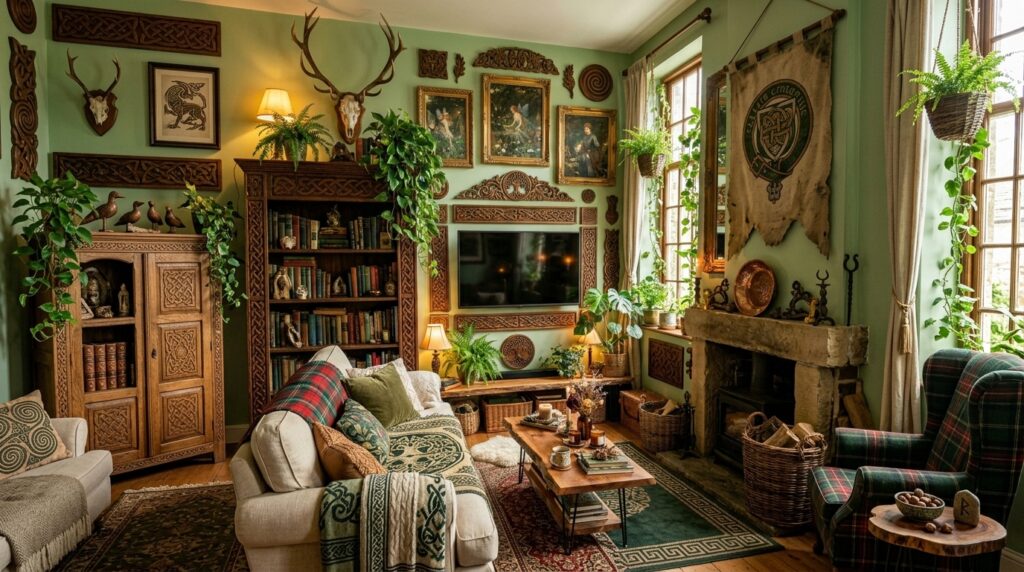
Sage green walls — not forest green, not near-black, the specific green of new growth in early spring, the green of the hills before the season has fully committed to anything. Against them: carved dark wood Celtic knotwork panels framing the television, a tree of life medallion at the center, oak leaf carvings at the corners, interlace border strips between them. The wall is not decorated. It is inscribed.
On the left: a dark wood bookshelf packed with books and small ceramics and trailing pothos. Above it: a mounted antler with deer skull beside it — not a hunting trophy, a natural finding, a piece of the forest brought inside. On the right: the window with trailing pothos and a large monstera in the light, and beyond it the garden, which is the room’s continuation rather than its boundary.
The sofa has a Celtic knotwork throw blanket draped across it and tartan plaid cushions stacked against the arm. The coffee table is live edge dark wood on hairpin legs — the slab of wood that still shows where the tree was. On it: candles, dried botanicals, a ceramic mug, pine cones, a stack of books with something marking the place. The floor has a Persian rug layered with a faux sheepskin. A stone fireplace surround is visible at the right edge of the room. Every lamp is on. The room is warm.
10 Celtic Cottagecore Living Room Ideas
1. The carved Celtic knotwork panels are the room’s identity
Every other element in this room could exist in a dark bohemian living room, a dark academia study, a goblincore cottage. The carved Celtic knotwork panels framing the television are what make this room specifically Celtic. They are the decision that commits.
Celtic knotwork’s intricate interlacing patterns are deeply rooted in Scottish and Irish culture. Incorporating them into home decor through carved wood panels, rugs, throw pillows, and wall art adds a touch of
A carved wood Celtic knotwork wall panel set — tree of life medallion, interlace border strips, oak leaf corner pieces — positioned around the television or above the fireplace or along the main wall does what no paint colour or textile can do. It gives the wall a language. The knotwork patterns are not decorative motifs chosen for their appearance — they are a visual system developed over centuries to represent continuity, eternity, and the interconnectedness of all living things. Hanging them on the wall is a statement about what the room believes.
2. The walls are the green of early spring hills
Scottish and Highland-inspired homes do not shy away from earthy, dark colour schemes — green, brown, red, and blue walls are common, and the colour scheme feels very grounded and connected to the land. Modern homes tend to avoid these colours in favour of bright minimalist tones, but in a Celtic-inspired room they are exactly correct.
The sage green in this room is lighter than the forest greens of dark cottagecore and darker than the pastels of regular cottagecore. It is the specific green of the landscape the aesthetic comes from — the hills of Scotland and Ireland and Wales in early spring before the heather is fully out. It makes the carved wood panels read as darker and more ancient than they would against a white wall. It makes the fairy paintings glow in their gilt frames. It makes the trailing plants look like they grew there rather than were placed.
For renters: a sage green peel-and-stick wallpaper with a subtle botanical or Celtic motif achieves the same ground. One wall behind the main seating area changes the entire room.
3. The antlers belong on the wall
Scotland has a rich tradition of hunting and land connection, and many historic homes display deer heads and antler mounts on the walls — not as trophies in the contemporary sense but as a connection to the land and its animals, a recognition that the deer and the person who found it are part of the same continuous natural world.
A mounted antler set — naturally shed rather than hunted, which is widely available and significantly less expensive — on the wall beside the bookshelf connects the room to the forest outside it in a way that no plant quite manages. Antlers are the forest’s own architecture. They are grown and shed and regrown according to a seasonal rhythm that has nothing to do with human preference, which is exactly why they belong in a room built around the idea that the natural world has its own intelligence worth respecting.
Position them at eye height on the wall, with the deer skull or a small ceramic figure below and a trailing pothos reaching toward them from the shelf beside.
4. The fairy paintings in gilt frames
The fairy paintings in this room — two large gilt-framed oils depicting fairy figures in forest clearings, painted in the Pre-Raphaelite manner — are the room’s most explicitly mythological element. They are not ironic. They are not nostalgic kitsch. They are a genuine expression of the Celtic fairy faith — the belief, held across Ireland and Scotland and Wales for centuries, that the natural world is inhabited by presences that deserve acknowledgment.
John Anster Fitzgerald painted fairy scenes in the Victorian era with a specificity and seriousness that distinguished them from whimsical illustration. Richard Doyle’s fairy illustrations have the same quality — detailed, committed, slightly uncanny. Both are entirely public domain. A large Fitzgerald or Doyle fairy painting print in a gilt frame in the 20×24 range or larger, hung on the sage green wall above the knotwork panels, connects the room to a tradition of nature belief that predates Christianity in the British Isles and has never entirely disappeared from it.
5. The live edge wood furniture
Dark wood furniture with a sense of history and natural imperfection is central to the Highland and Celtic interior aesthetic. The goal is furniture that looks as though it has a story, that has been in the family or found somewhere specific — pieces with worn edges, natural grain, visible history.
A live edge wood coffee table — a slab of dark walnut or oak that still shows the natural edge of the tree it came from, mounted on hairpin legs or simple dark wood trestle legs — is the single most important furniture decision in a Celtic cottagecore living room. It is the tree, made into a table, still carrying the shape of what it was. A live edge wood TV console beneath the knotwork panels extends the same principle to the media furniture — the technology sits on wood that remembers being part of something living.
The live edge furniture does not need to be expensive. A single live edge slab on hairpin legs costs $150–300 and changes the room’s relationship to its own materials more than any decorative object.
6. Tartan as the room’s textile language
Tartan fabric is synonymous with Scottish Highland culture — each pattern historically connected to a specific clan and a specific territory. Incorporating tartan into a Celtic cottagecore living room through throw blankets, cushions, and upholstery adds not just pattern but provenance — the suggestion that the textiles in the room come from somewhere specific.
A tartan plaid throw blanket draped over the sofa arm. Tartan cushions in deep red and green and navy mixed with the Celtic knotwork cushions. A tartan upholstered ottoman used as a footrest or additional seating. The tartan does not need to match — different patterns in the same colour family read as collected rather than coordinated, which is the correct register for this aesthetic.
The Celtic knotwork throw and the tartan throw should coexist on the same sofa. They are both correct. The room’s textile language is Celtic in the broad sense — knotwork and tartan are different expressions of the same cultural inheritance.
7. The sacred tree — the tree of life as the room’s anchor symbol
The tree of life is the most important symbol in Celtic mythology. It represents the connection between the upper world, the middle world, and the lower world — the roots in the earth, the trunk in the present moment, the branches reaching toward what is above. It appears carved above the television in this room as a central medallion in the knotwork panel arrangement, which positions it as the room’s symbolic centre rather than its decorative centrepiece.
A carved wood tree of life wall medallion mounted above the fireplace, above the television, or at the centre of the main wall is the room’s statement piece. A tree of life tapestry hung on the wall beside the bookshelf is the textile version of the same symbol. A tree of life carved bookend set on the shelf among the books is the smaller, everyday version.
The symbol does not require belief to be meaningful in a room. It requires acknowledgment — an awareness that the tree has been considered sacred by the people whose cultural inheritance this aesthetic draws from, and that placing it in the room is a form of respect for that tradition.
8. The plants are the room’s living mythology
The Celts were deeply connected to the natural world, and specific plants carried sacred significance — the oak was the tree of the druids and the symbol of strength and endurance, the ivy represented eternal life and connection, the fern was associated with the fairy world and the hidden pathways of the forest.
A large trailing pothos on top of the bookshelf, trailing down across the spines of the books. A hanging pothos in a wicker planter from a ceiling hook in the corner by the window. A large monstera in a dark ceramic pot on the windowsill where the light is best. Ferns in terracotta pots on the TV console beside the knotwork panels.
The plants in a Celtic cottagecore room are not styled. They are growing — toward the light, around the carved panels, over the bookshelf, into whatever space is available. The room accommodates them. The suggestion is that the forest has a standing invitation and has been quietly accepting it.
9. Wicker, wool, and the handmade things
Cottagecore values handcrafted imperfection over polished minimalism — the items in the room should look as though they were made by someone rather than manufactured by a process. Wicker baskets, woollen textiles, handthrown ceramics, and natural fibre rugs all carry this quality.
Wicker storage baskets beneath the TV console holding throws and books. A wool cable knit throw across the back of the sofa — not folded, draped. A handthrown ceramic mug on the coffee table. A natural fibre jute rug layered beneath the Persian rug where the floor is visible at the edges. A faux sheepskin rug on the floor in front of the fireplace.
Harris Tweed — handwoven in the Outer Hebrides of Scotland — is the luxury textile expression of this aesthetic. A Harris Tweed cushion or throw instantly elevates the room with a quality that mass-produced fabric cannot replicate. It is available online and its provenance is part of what it is.
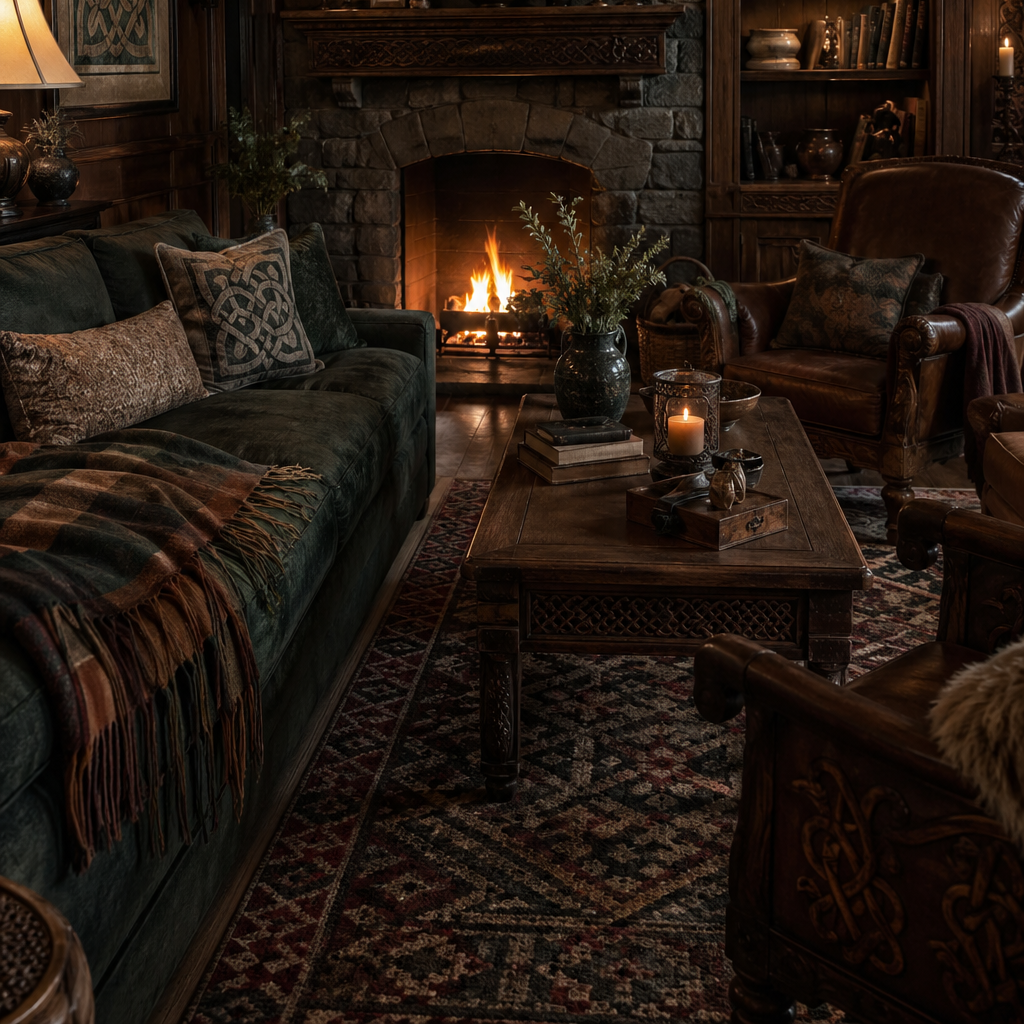
10. The stone fireplace is the room’s heart
Every Celtic cottagecore living room should have a fireplace or should be working toward one. The fire is the oldest gathering point in human domestic life — the place where the family assembled, where the stories were told, where the ancestors were remembered, where the night was kept at bay.
A stone or exposed brick fireplace surround is the architectural ideal. For rooms without one, a freestanding electric fireplace in dark surround or a cast iron electric log burner achieves the visual and atmospheric effect. Position it as the room’s focal point — the knotwork panels can frame the television but the fireplace is the anchor. A brass fireplace tool set beside it. A wicker log basket with actual wood in it even if the fireplace is electric. Pillar candles in brass holders on the mantel above it.
Light the fire or the candles or both when the evening comes. The room becomes a different kind of place after dark — warmer, more enclosed, more like the thing it is trying to remember.
The Bookshelf and the Books It Should Hold
The dark wood bookshelf in a Celtic cottagecore living room is not a display of carefully selected spines arranged by colour. It is a library that reflects a particular relationship with the world — books kept because they matter, interspersed with small objects that carry the same weight.
The books themselves should include the source material for the aesthetic. The Mabinogion — the Welsh mythological cycle that contains some of the oldest Celtic stories in any written form. Lady Gregory’s collections of Irish mythology. Robert Graves’s The White Goddess, which is a sustained argument for the sacred nature of the natural world expressed through poetry and myth. Alan Garner’s novels, which are set in the landscape of the Celtic north of England and treat its mythology as present rather than historical. Any edition of the Arthurian cycle — Malory, Tennyson, T.H. White — that has been read enough times to have a broken spine.
Between the books: a small Celtic cross wall plaque. A triquetra or trinity knot carved wood piece. A green man carved wall mask — the foliate head that appears on medieval church carvings across the British Isles, the face of the forest looking back from the stone. A small ceramic or resin stag figurine. A trailing pothos growing where it wants.
The shelf should look like it belongs to someone who has been thinking about these things for a long time and has the books to prove it.
How To Start
Start with one carved panel. A tree of life medallion mounted on the wall above the television or fireplace costs $30–80 and immediately declares the room’s direction. Nothing else needs to change. The declaration is enough to begin.
Add the Celtic knotwork throw second. Drape it over the sofa. The room now has two elements that speak to each other — the carved wood on the wall and the woven pattern on the textile. The room has begun to have a language.
Buy the tartan cushions third. They complete the textile conversation and add the Scottish Highland note that grounds the room in a specific geography rather than a generic aesthetic.
The live edge furniture, the fairy paintings, the antler mount, the bookshelf full of mythology — these come over time. The Celtic cottagecore living room does not arrive all at once. It rewards patience, personal taste, and the slow accumulation of things chosen because they mean something rather than because they coordinate.
The room is not finished when the last object is placed. It is finished when it starts to feel like somewhere you have always been going. That is when you know it remembers where you came from.