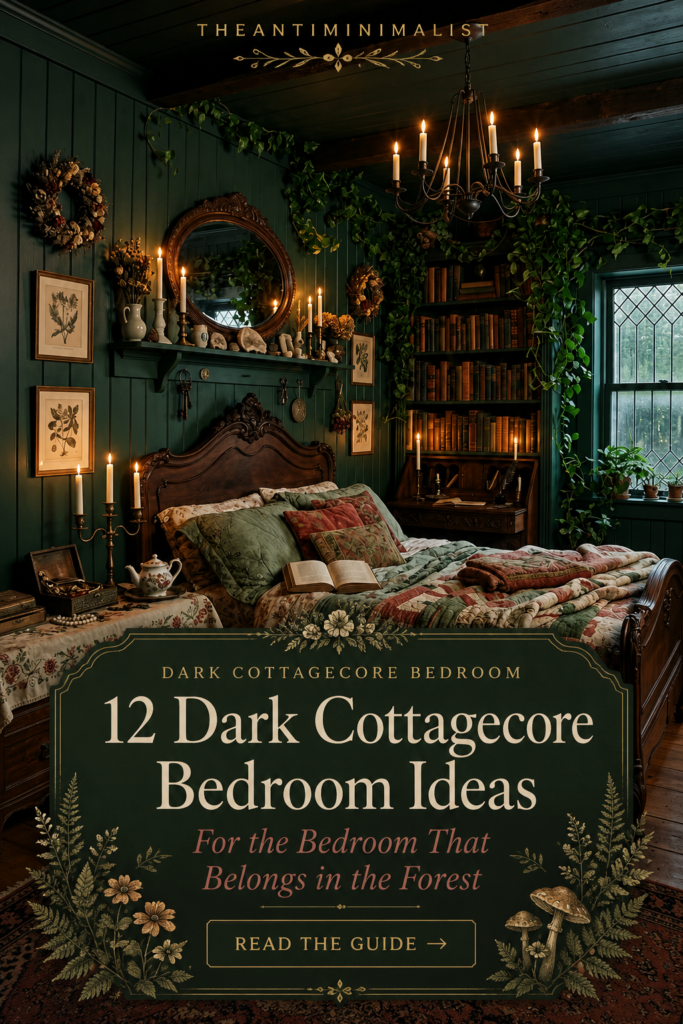
A dark cottagecore bedroom is a small act of relocation — the room where you go to sleep is supposed to feel like the forest cottage you have not yet bought, not the rental apartment you currently pay for. The aesthetic exists because the actual cottage in the actual woods is, for most people, several life decisions away, and the bedroom is the one room where the gap is most easily closed. The 12 ideas below are the exact objects, in roughly the order to acquire them, that move a modern bedroom into a forest one.
12 Dark Cottagecore Bedroom Ideas
1. Lay a Burgundy and Cream Persian Rug Across the Bedroom Floor Before the Bed Comes In
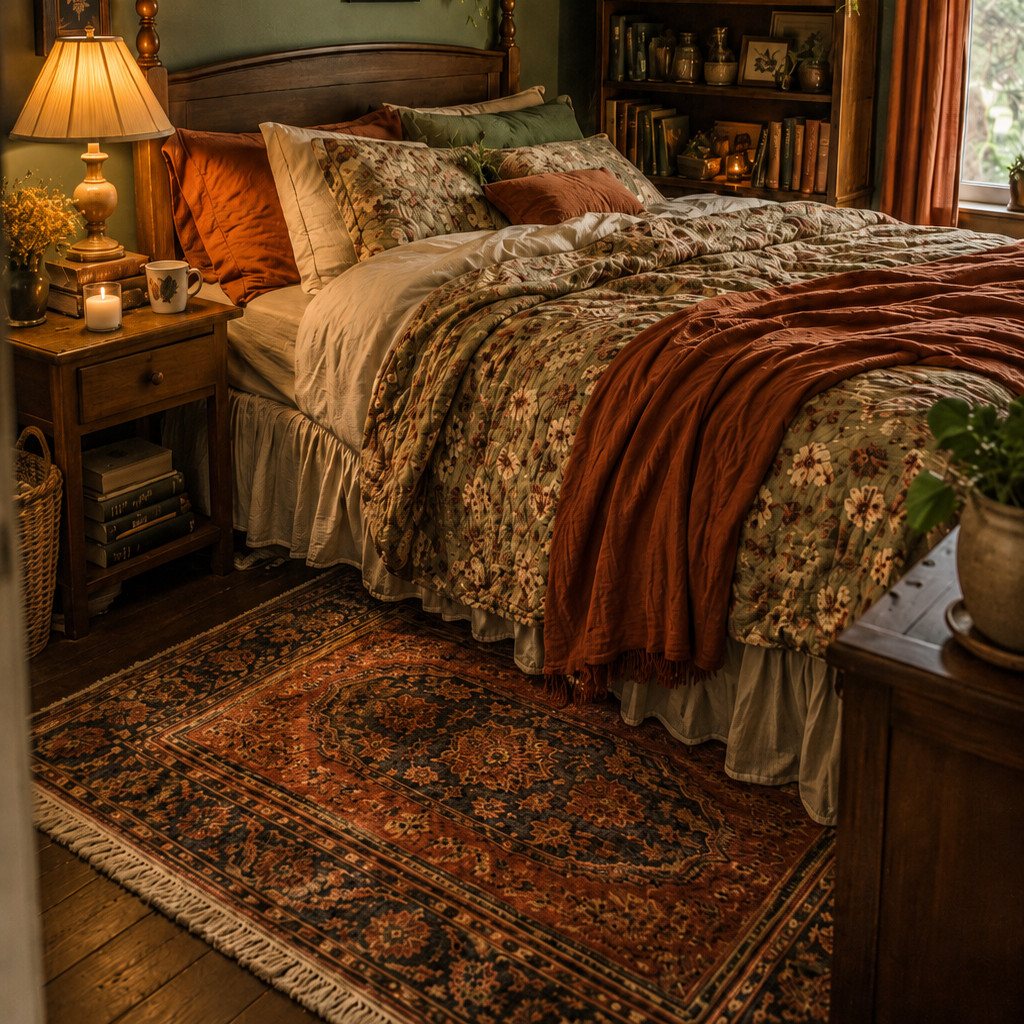
The rug is the floor of the cottage. A burgundy and cream Persian — warmer and softer than the burgundy and navy used in dark academia rooms — sets the colour temperature of the entire room before a single piece of furniture goes in. It softens the wide-plank wood floor or covers the laminate you actually have, and ties the bed, the armoire, and the curtains into a single warm palette. Lay it before you move the bed in. The rug decides where the bed wants to sit, not the other way around.
Copy this idea:

2. Replace the Modern Bed Frame With a Carved Antique-Style Wooden Bed That Looks Like It Was Built in a Workshop
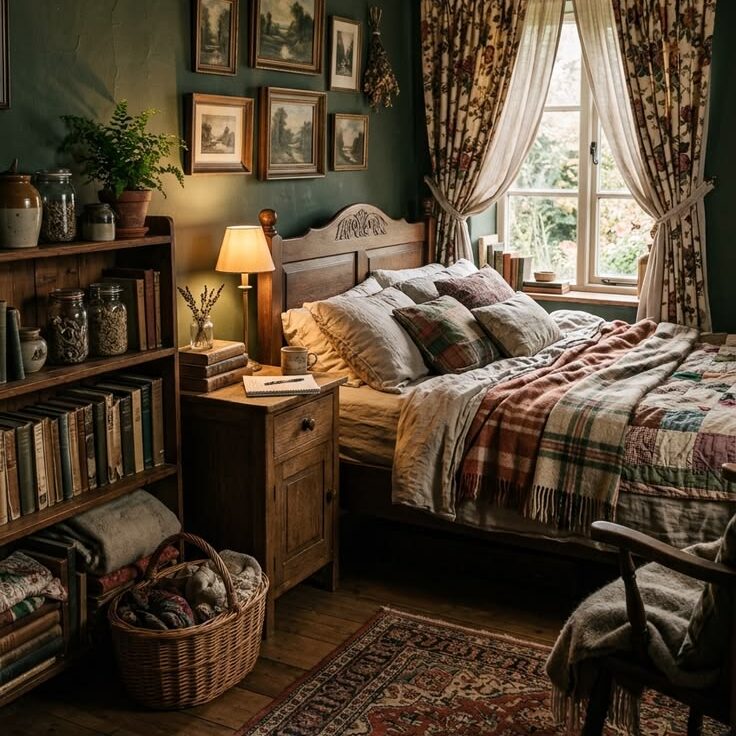
The carved wooden bed is the single most consequential piece of furniture in a dark cottagecore bedroom and the one most readers underinvest in. A high headboard with hand-carved detail, a matching footboard, a warm walnut or aged oak finish — this is the piece that decides whether the room reads as cottage bedroom or as “a bedroom with floral curtains in it.” The platform bed has no business in this aesthetic. The IKEA Malm has no business in this aesthetic. The bed should look like it was assembled in a workshop two villages over and dragged into the room by people who knew it would never leave. Once it is in, every other object in the room has its register set.
Copy this idea:

3. Cover the Bed in a Layered Patchwork Quilt That Looks Like It Has Been Slept Under for Decades
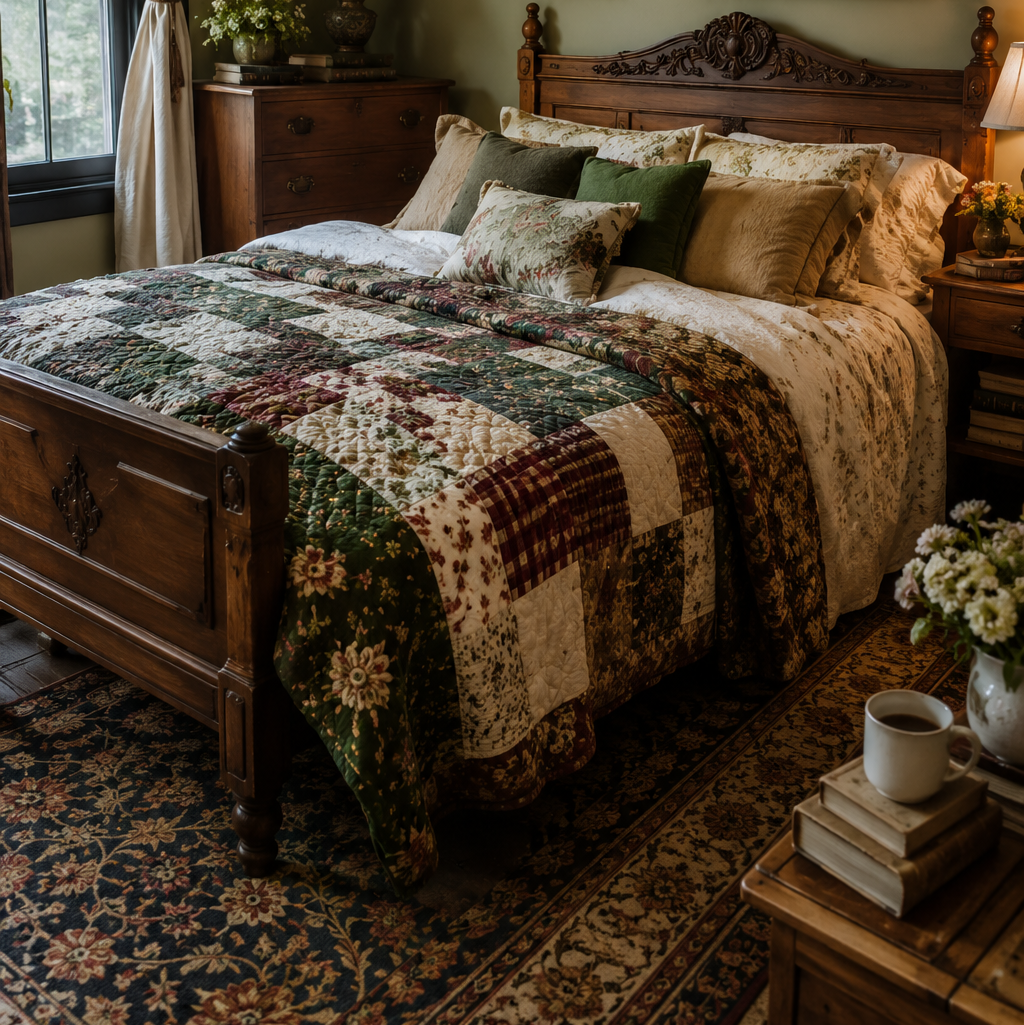
The bed wants a patchwork quilt and nothing else will do. A heavy cotton patchwork in greens, burgundies, and creams — gingham, florals, small geometric prints, a few solid panels — folded once at the foot of the bed and layered over a cream linen duvet, gives the room its single most important quality: the look of having been inhabited by someone who keeps quilts. Buy the heaviest one you can find. The quilt does not require styling — it gets better the more it is used.
Copy this idea:

4. Bring in a Carved Wooden Armoire to Replace Every Particleboard Wardrobe You Have Ever Owned
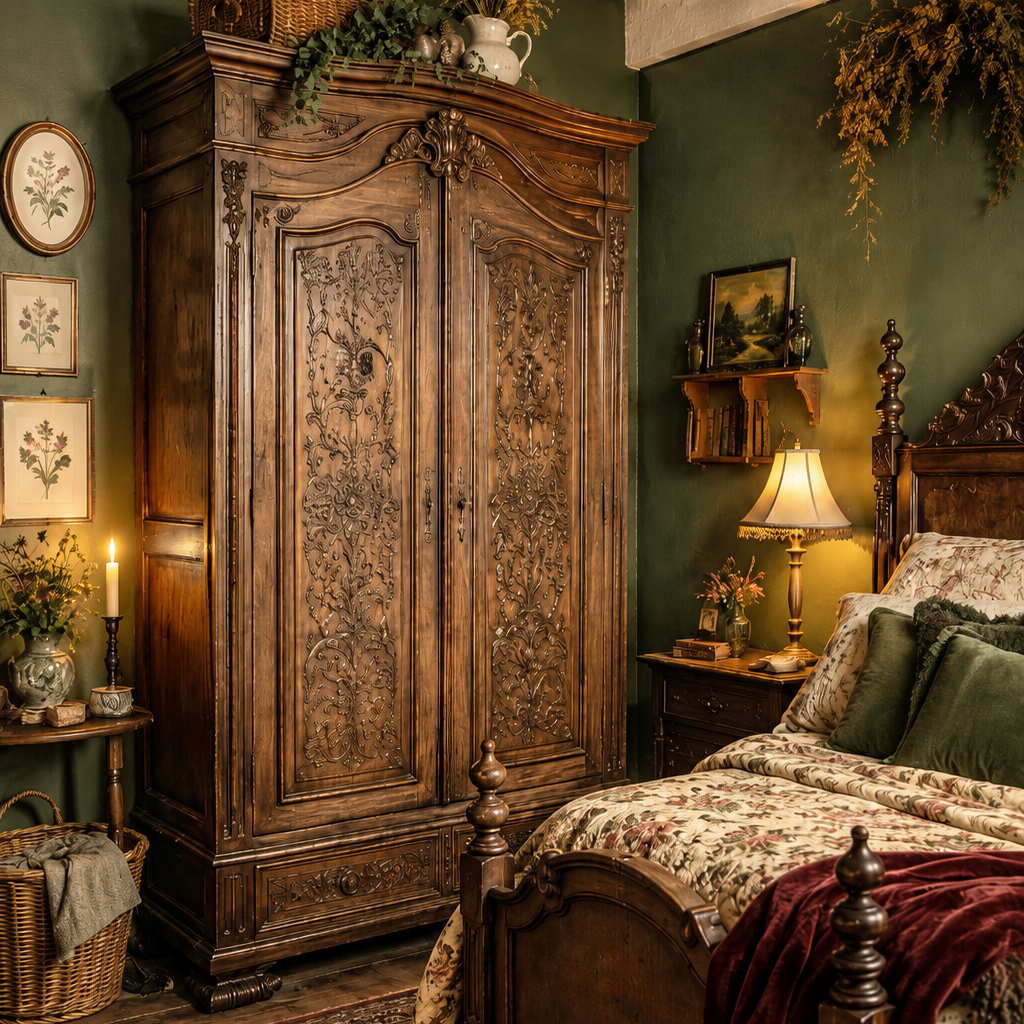
The armoire is the second most important purchase in the room. A carved wooden armoire — double doors, decorative panels, the kind of brass hardware that has aged on its own — does the job of three pieces of modern furniture at once: it provides clothing storage, it gives one wall of the bedroom serious architectural weight, and it makes the room read as a bedroom from a different century. The modern wardrobe is one of the most aesthetically destructive pieces of furniture sold today. Replace it. The armoire is the kind of object that gets passed down to someone, and the room treats it accordingly.
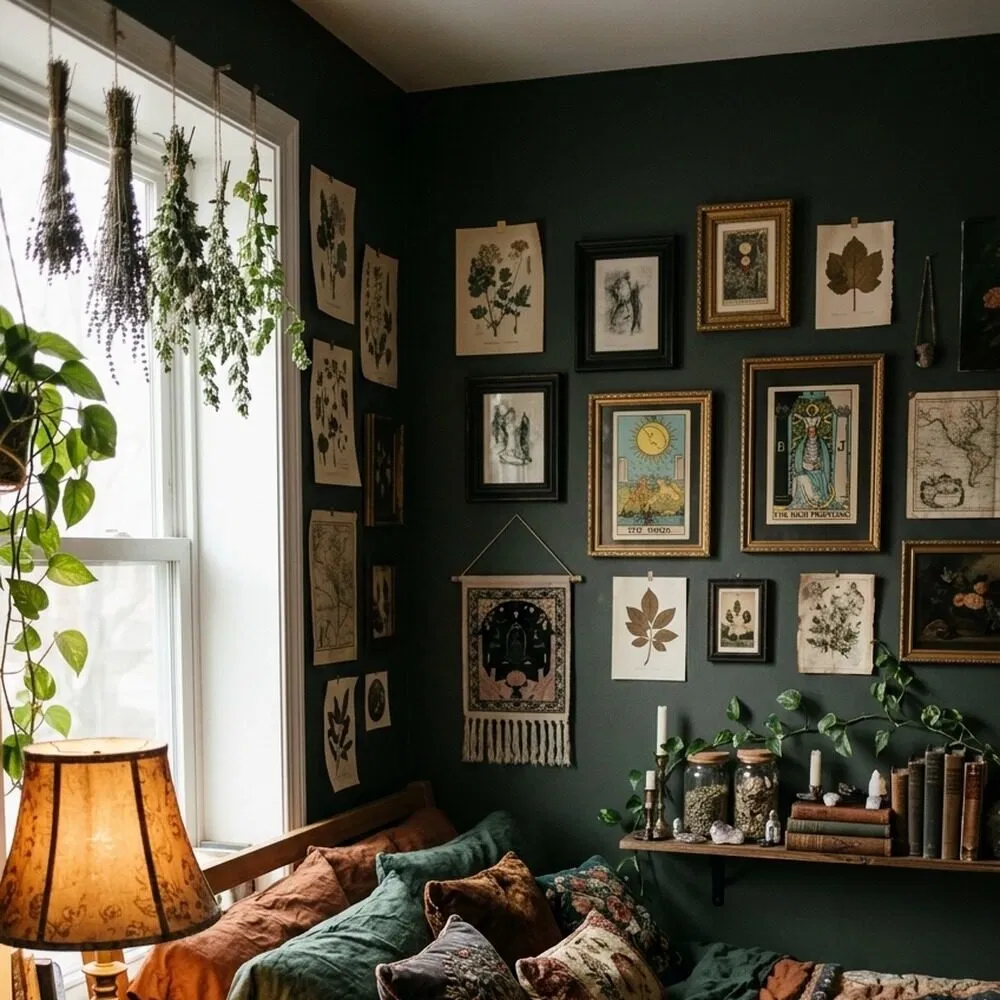
5. Hang Dried Botanical Bundles, Wreaths, and Herb Bunches on Every Wall That Has Empty Space
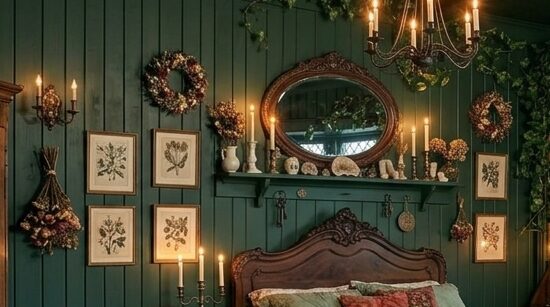
The dried botanicals are not decoration in the conventional sense — they are evidence that the inhabitant of this room has a relationship with plants outside the bedroom. Hang a bundle of dried eucalyptus and lavender from a brass hook beside the bed. Hang a dried floral wreath on the wall above the armoire. Tuck a small bunch of dried wildflowers into the corner of the mirror. The room should smell faintly of lavender and dried sage at all times. The empty wall is the enemy of cottagecore, and dried botanicals are the most reliable, lowest-cost way to fill it without buying a single additional piece of art.
Copy this idea:


6. Layer Floral Cottage Curtains Behind Sheer Cream Panels So the Window Looks Like It Belongs to a Farmhouse
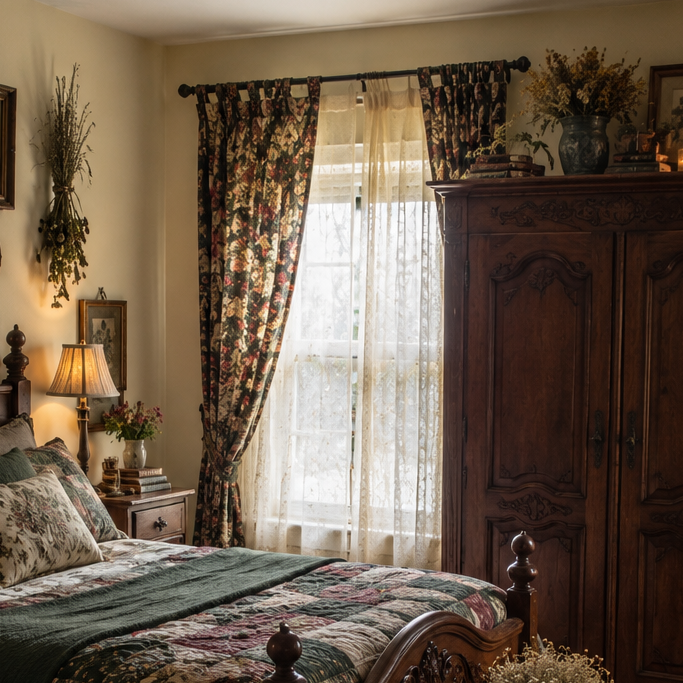
The window is the most important architectural feature of a cottagecore bedroom, and the curtains are what make it look like the window of a cottage rather than the window of an apartment. Layer a heavy floral curtain — small print, burgundy and forest green and cream — behind a cream sheer panel so the morning light filters in through two layers. Pull the floral panel back during the day with a length of natural twine or a brass tieback. The double layer is the entire point. A single curtain looks rented. The layered set looks like the inhabitant has been living here long enough to have considered the question.
Please ignore how basic the amazon mockups are, but these are some good options.
Copy this idea:


7. Put a Tiffany-Style Stained Glass Lamp on the Bedside Table and Never Use the Overhead Light Again
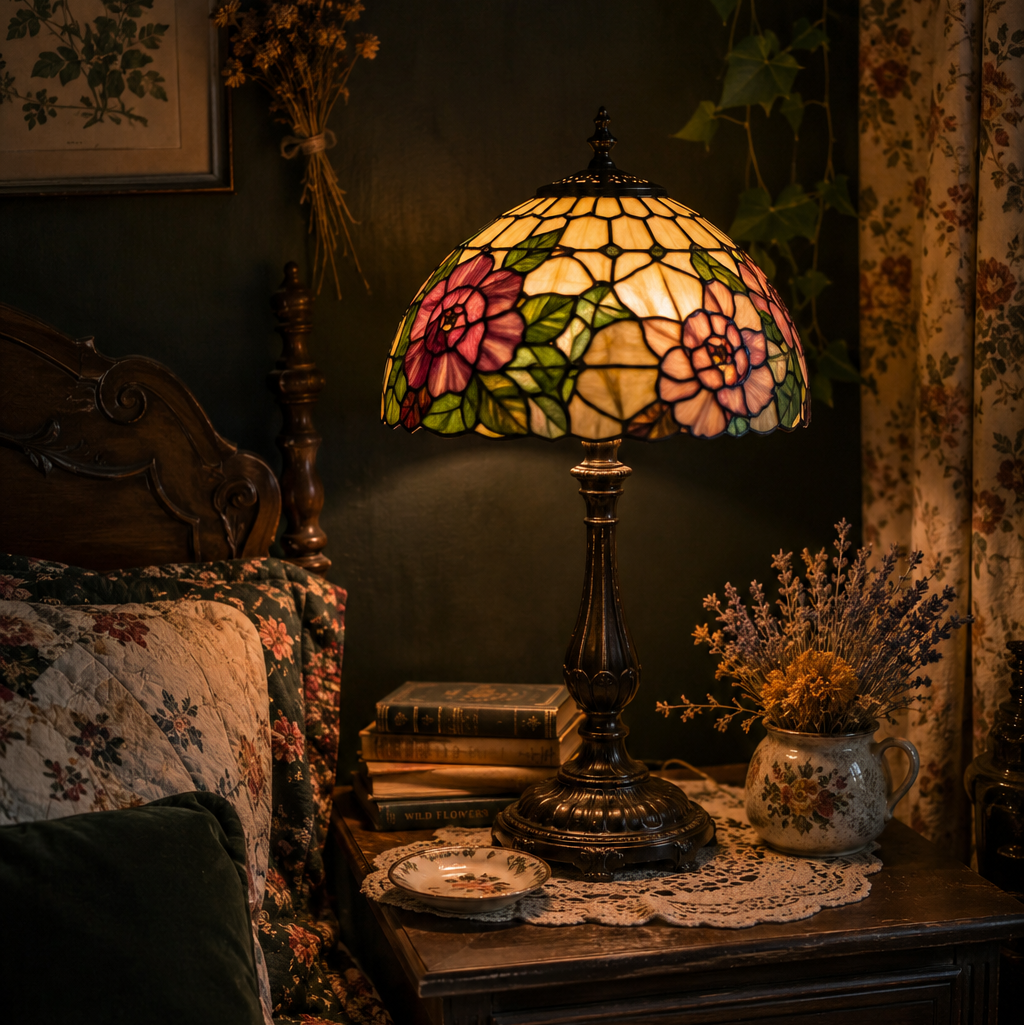
A Tiffany lamp is not exclusive to dark academia — the cottagecore version uses a softer, floral or rose-coloured shade rather than the geometric green and amber of the academic version, and it does the same essential work. The stained glass throws coloured light across the wall and ceiling, the bronze base reads as something inherited rather than purchased, and the room shifts entirely once the overhead light is switched off in favour of it. Place it on the bedside table closest to the side of the bed you actually sleep on. Read by its light. The overhead bulb is for finding things you have dropped, not for any other purpose in a bedroom like this.
Copy this idea:

8. Hang a Carved Oval Mirror Above the Dresser and Flank It With Brass Wall Sconces
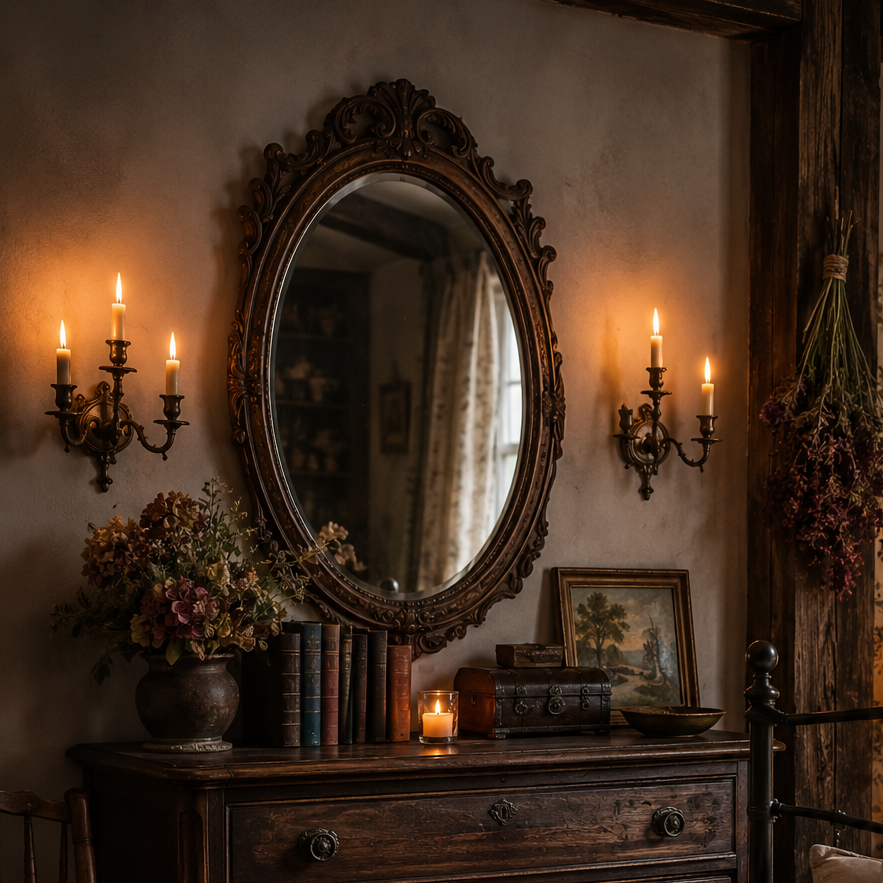
The wall above the dresser asks for a focal point and the answer is rarely another framed print. A carved oval mirror — wood with aged gilt detail, or pure aged brass — flanked by two brass wall sconces, gives the dresser an immediate sense of being placed rather than parked. The mirror catches the lamp light and the morning light and bounces it back across the room, which makes the bedroom feel about a third larger after dark. Use real taper candles in the sconces on evenings the room earns it, or candle-style bulbs the rest of the time — the silhouette of the flame against the brass is what’s doing the visual work, and either version reads correctly from across the room.
Copy this idea:


9. Let Trailing Pothos and Ivy Spill From Every High Shelf and Drape Across the Ceiling Beams
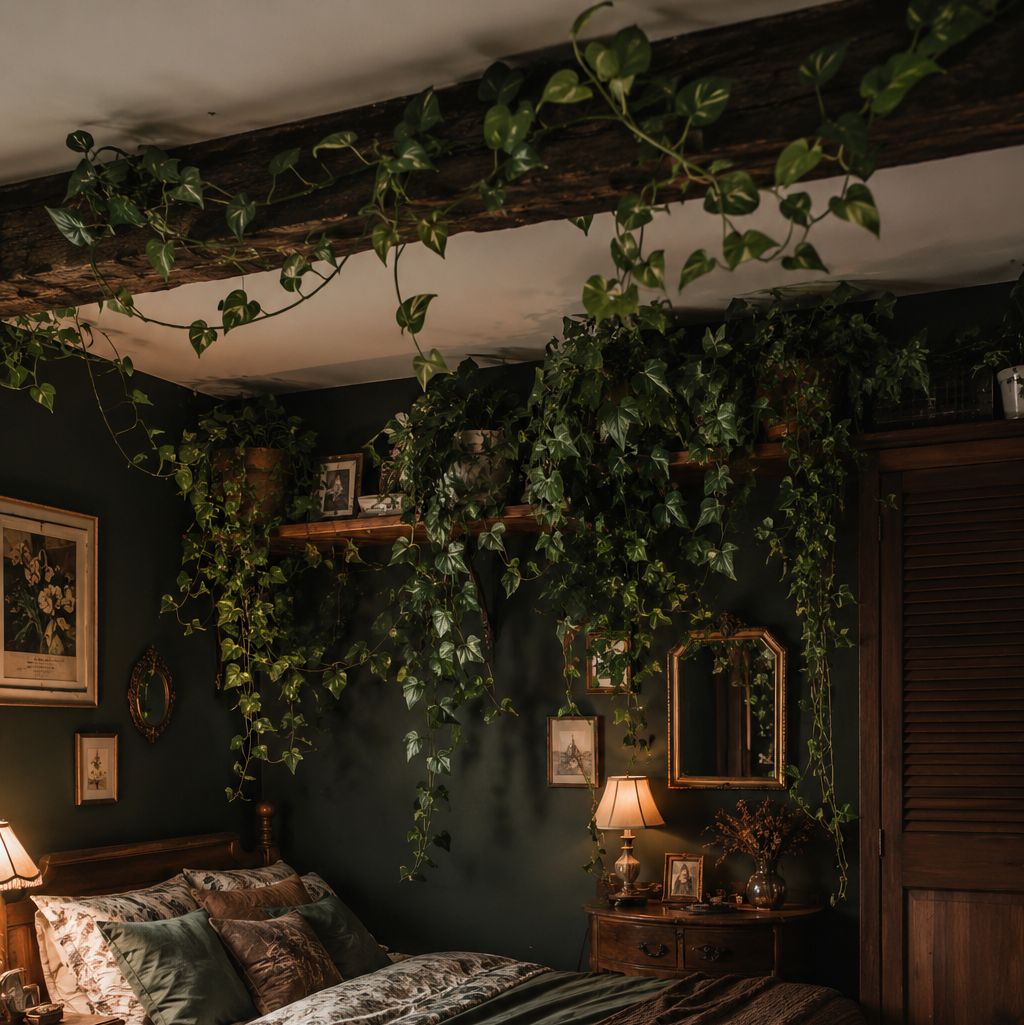
The plants are not optional. A cottagecore bedroom without trailing greenery is just a boring bedroom with dark green walls — it doesn’t work. A pothos on top of the armoire with vines long enough to drape down across the door. An English ivy on the high shelf above the bed, allowed to hang down toward the headboard. A smaller fern on the bedside table. The greenery makes the room read as overgrown in the right way — as though the cottage has been there long enough for the forest to start coming inside. Aged terracotta pots only, or vintage brass cachepots. The plants are doing real work, and they should not be undermined by a $4 white nursery pot.
Ideally, you’d want real plants, but that’s a lot of time, work, and cost. Faux plants will do. Here are a couple great options.
Copy this idea:


10. Anchor the Foot of the Bed With a Wooden Blanket Chest That Looks Like It Has Crossed Continents
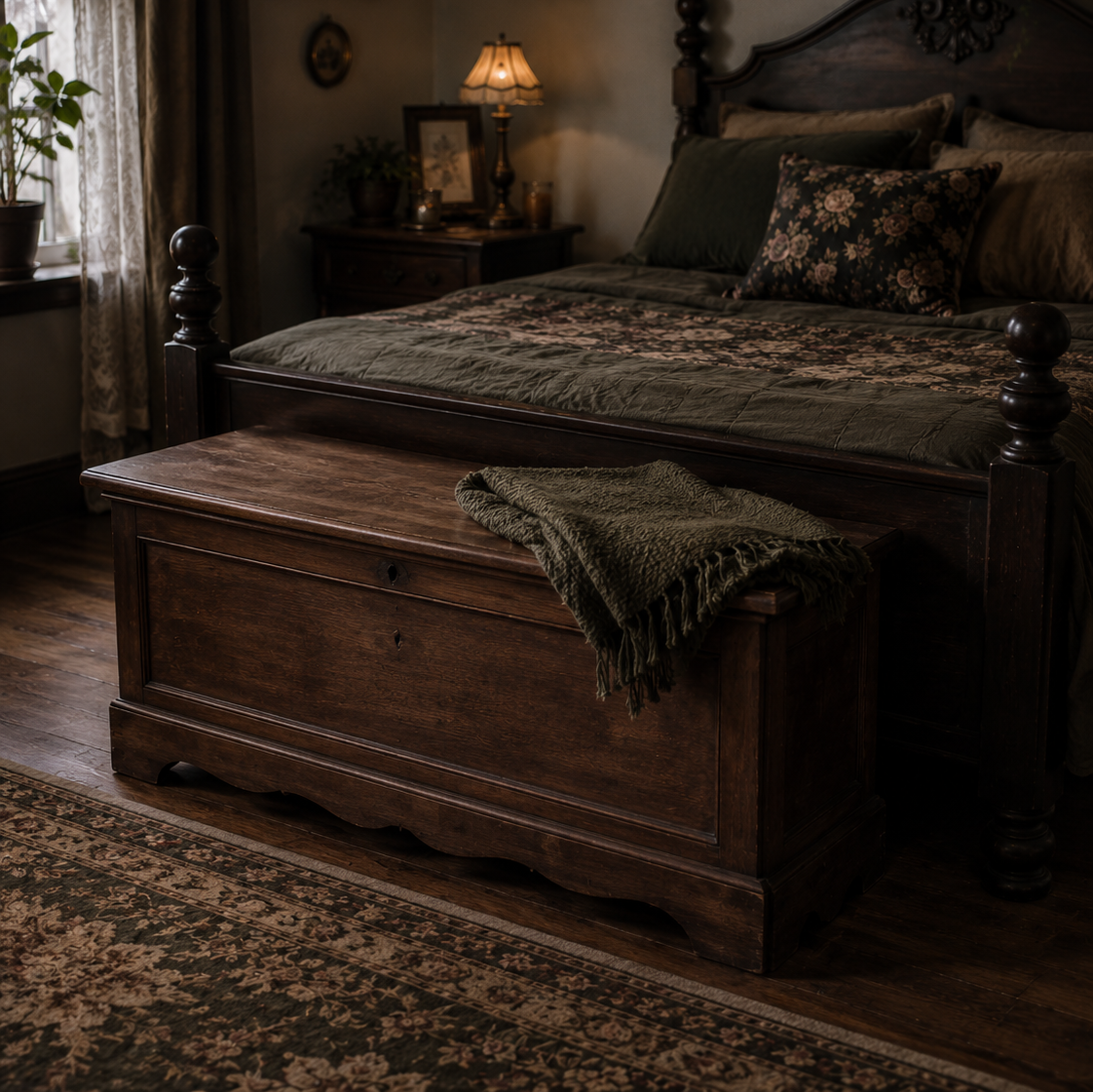
The foot of the bed asks for something, and the wooden blanket chest answers. A solid wood chest — pine or oak, with iron hinges and a hammered iron clasp, the kind that looks like it has been used as both furniture and luggage — gives the bed a base, provides storage for the second and third quilts the room will accumulate, and turns the foot of the bed into a place to sit while putting on socks. Drape one folded quilt over the lid. Place a brass candlestick and a stack of two or three worn-spine books on top. The chest is the difference between a bedroom and a bedroom that looks like someone packed a trunk to arrive in it.
Copy this idea:

11. Hang a Gallery of Small Landscape Paintings and Botanical Prints in Mismatched Wood Frames
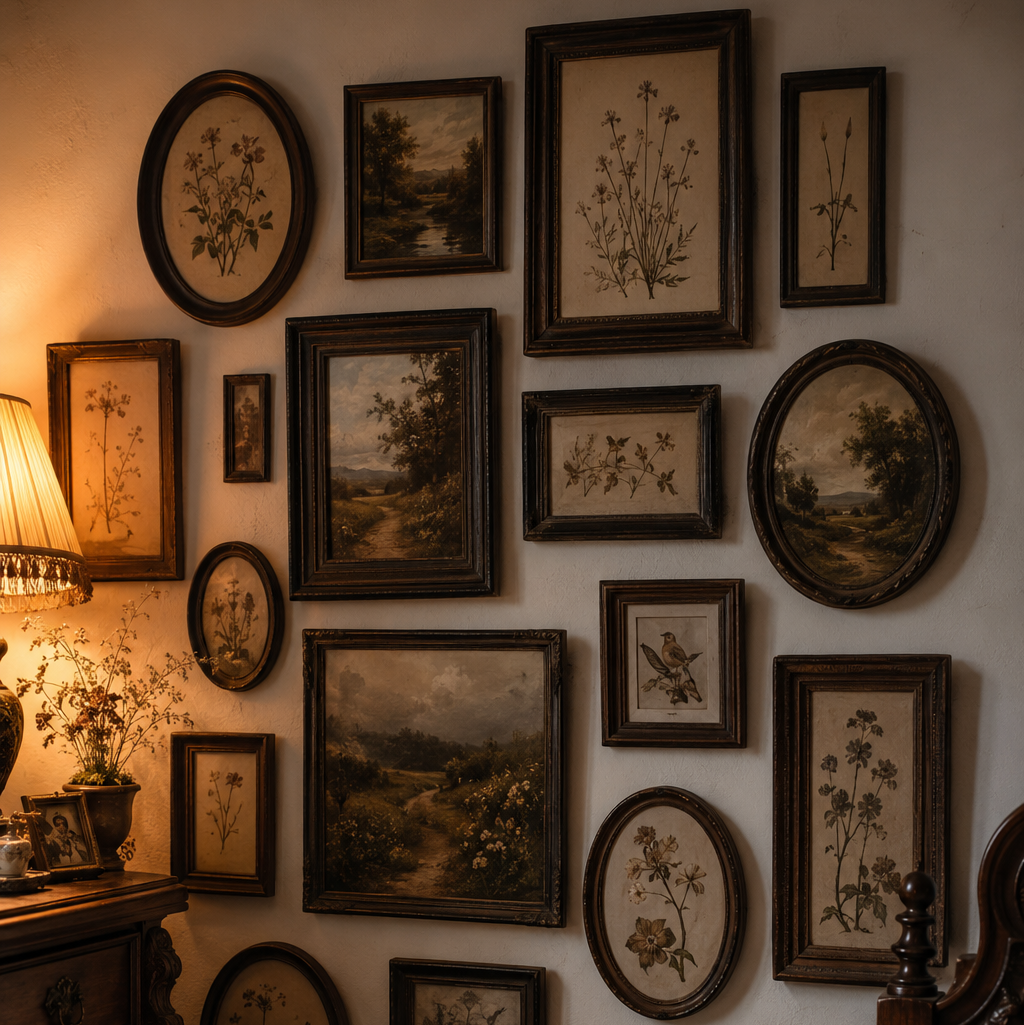
The cottagecore gallery wall is quieter than its dark academia counterpart. Six to ten small frames — pastoral landscapes, hand-coloured botanical illustrations, herbarium specimens, a small print of a hare or a fox — clustered above the bedside table or above a low bookshelf, in dark wood frames that do not match. No portraits of strangers. No ornate gilt. The frames should look like they came out of a country auction. The prints should look like they came out of a 19th-century natural history book. The wall reads as the visual record of someone who pays attention to plants and weather, which is exactly the identity the room is built around.
Copy this idea:

12. Stack the Bedside Table With Worn-Spine Books and a Linen-Bound Journal
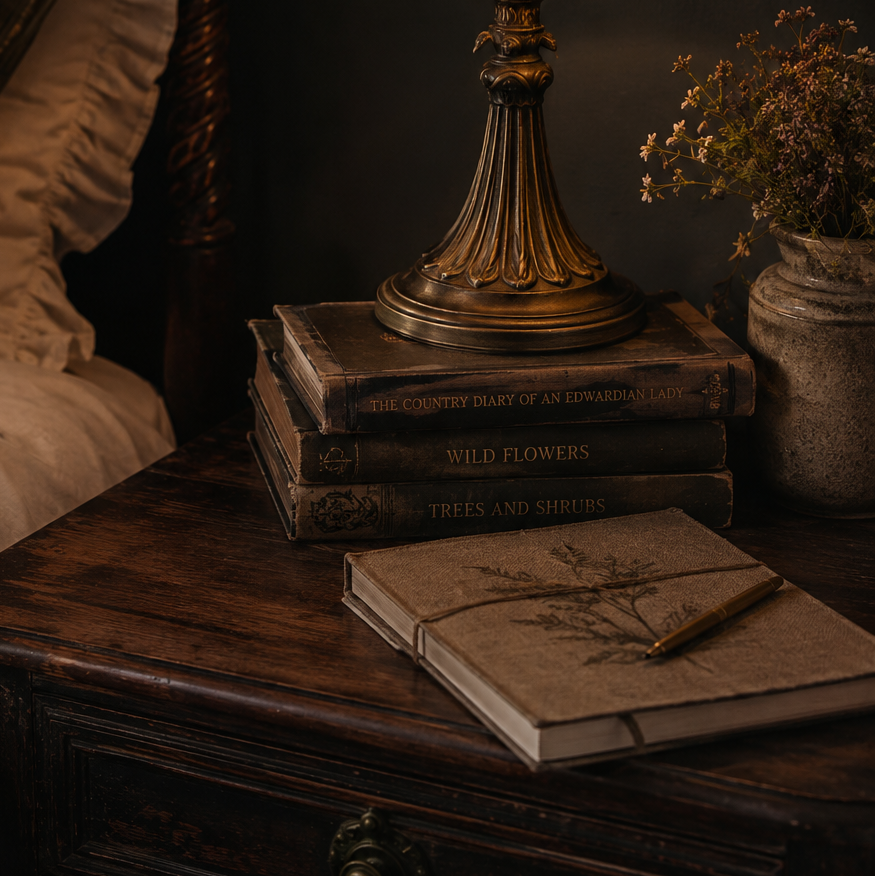
The bedside table is the most personal real estate in the bedroom and the place where the room most quickly reveals what kind of person lives in it. A stack of three to six worn-spine hardcovers — vintage cloth-bound classics, used hardback novels, a slim poetry volume — topped with a linen-bound journal and whatever object you actually reach for at night, does more for the room’s identity than any decorative purchase you could make. The pile shouldn’t be tidy. The stack gets better the more it’s added to, and the books on top should rotate with what you’re actually reading. Vintage cloth-bound book sets on Amazon — green or cream classics in particular — read identically to estate sale finds in photographs and cost under $40 a set.
Copy this idea:


Where To Start (And What You Can Add for Under $100)
The cheapest first moves are the ones that change the room fastest. If you’re working with a budget, the highest-leverage opening sequence is dried botanicals, plants, a layered curtain panel, and the worn-spine books on the bedside table — all under $40 each, all available immediately, and all capable of visibly shifting the room before any furniture decision gets made. Build the atmosphere first. The furniture rounds out the room later.
Then move to soft furnishings. A patchwork quilt, layered floral curtains with sheer panels, and embroidered cushions are the second round — still mostly under $100 each, and the layer that gives the bed and window their cottagecore signature. These are also the items most worth buying new, since they need to be heavy, washable, and durable.
Lighting before furniture. A Tiffany-style table lamp at $60–120 changes how every other object in the room reads. It’s a more impactful purchase than another piece of furniture at the same price, and it’s worth ahead of the armoire in most build sequences.
The big-ticket pieces last, and patiently. The carved bed frame, the carved armoire, the wooden blanket chest — these belong in the room eventually, but they don’t all need to arrive in the first six months. Watch Facebook Marketplace, local estate sales, and antique shops. Real antiques in this category routinely sell for less than the new reproductions, and the patina is the point.
Paint the walls forest green or aubergine when you’re ready. This is the single biggest aesthetic shift. If you can’t paint, a tall wall hanging or a large tapestry behind the bed creates the same depth on the wall the bed sits against.