
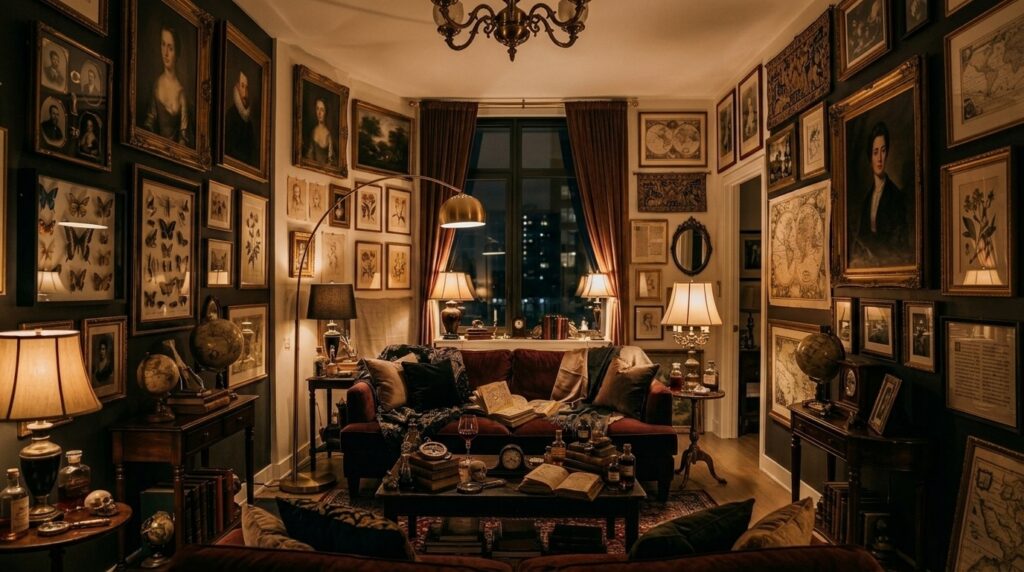
I have been thinking about what a vampire’s apartment actually looks like. Not the castle. Not the crypt. The apartment — the one they moved into sometime in the last decade because the castle became impractical and the crypt had a damp problem. If Dracula were to move from the countryside to a city today, what would that apartment look like? Well, he’d probably bring everything with him. The oil portraits. The Persian rugs. The five lamps because overhead lighting was not invented until long after his taste was fully formed and he sees no reason to start now. The decanters on the side table that may or may not contain… wine. The books stacked on the coffee table because the bookshelf ran out of space sometime in the 1800s and the overflow has been accumulating ever since.
The result is a room that looks warm and inhabited and slightly inexplicable. Every surface has something on it that raises a question. The walls are covered in portraits of people who may or may not be family. There is a compass on the coffee table next to an open book that no one remembers starting. The curtains are heavier than they need to be. It is eleven o’clock at night and every lamp in the room is on and it still feels like dusk.
This is the vampire romantic aesthetic in a real apartment. Here is how to build it without the centuries.
The Look
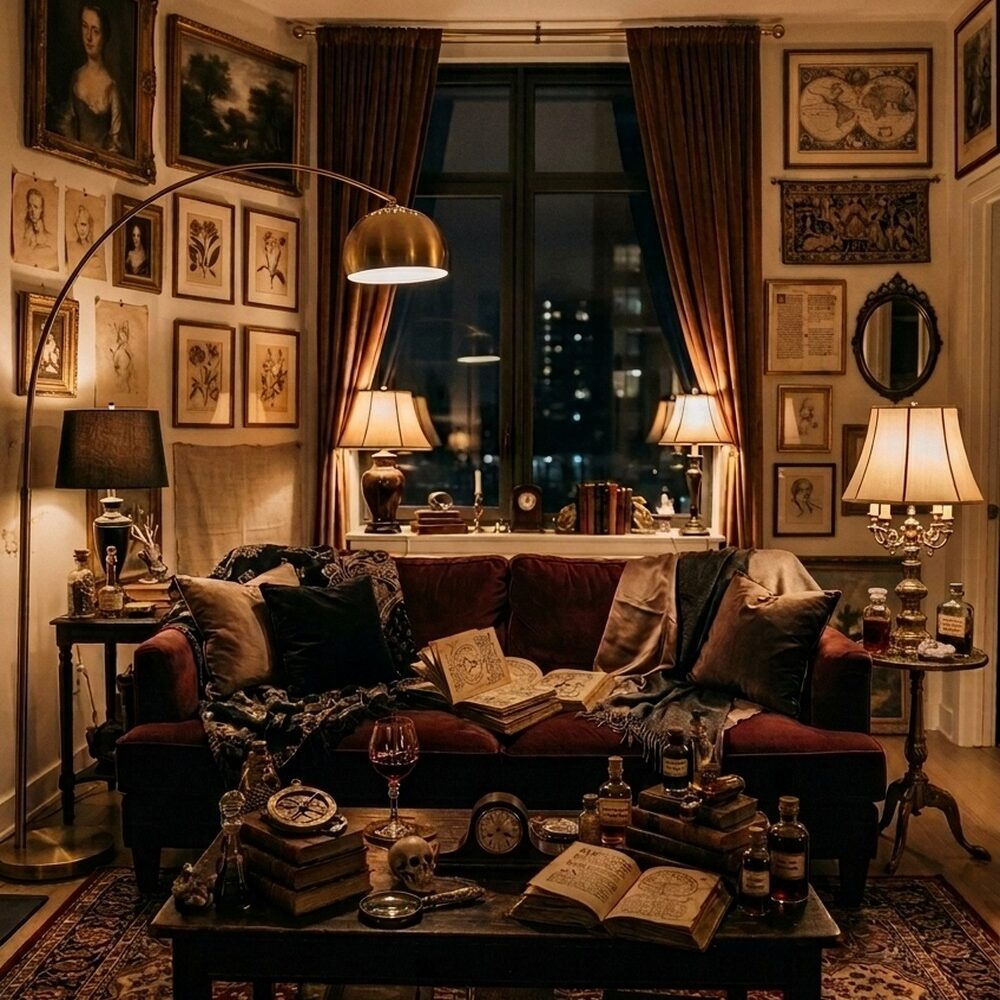
The room starts with layered light. Not overhead light — never overhead light. A brass arc floor lamp behind the sofa. Two ornate table lamps with warm amber shades flanking the window. A candelabra on the side table that is used regularly, not decoratively. The room should feel lit from within rather than illuminated from above. Five light sources is not too many. Five light sources is the beginning of a conversation about atmosphere.
The sofa is deep burgundy velvet — a Chesterfield or something close to it, tufted, the kind that looks better with a throw draped across it than without. The coffee table in front of it is dark wood, low, and covered in things: an open book, a compass, a skull, a glass of something dark, a clock that may or may not be accurate. None of this was styled. All of it belongs to someone who lives like this.
The walls are covered. Not decorated — covered. Oil portraits in gilt frames. Botanical prints. An antique map in the upper right corner. A tapestry on the left. A mirror in a dark ornate frame between two portraits. The wall is a document of a very long life and it looks exactly like that.
10 Ways To Decorate Like You’ve Occupied It Since 1742
1. Commit to layered light and abolish the overhead
The single most important decision in a vampire romantic room is the refusal of overhead lighting as a primary light source. A room lit entirely from above looks like an office. A room lit from multiple sources at varying heights — floor level, table level, wall level — looks like somewhere someone actually lives, which in this case means somewhere someone has been living for a very long time.
Start with a brass arc floor lamp positioned behind and to the side of the main seating. Add [table lamps with fabric shades in warm amber or deep burgundy on every surface that can hold one. Add a candelabra with real tapers on the side table or mantel. The overhead light stays off after dark. The room adjusts. Within a week it will feel wrong to turn it on.
2. The sofa is the room’s centre of gravity
Everything in a vampire romantic living room orbits the sofa. It should be deep burgundy or oxblood velvet, Chesterfield-tufted, with arms wide enough to drape a throw across and cushions that have developed a permanent impression from years of use. The colour matters more than the silhouette — a burgundy velvet sofa in a room full of warm lamp light and gilt-framed portraits reads as a piece of furniture that has been in this room for decades. A grey linen sofa in the same room reads as a mistake.
Layer it. A dark velvet throw across one arm. Two or three [embroidered or brocade cushions in deep jewel tones. An open book face-down on the cushion as though someone just stood up. The sofa should look occupied even when it isn’t.
3. Cover the walls like you’ve been collecting since the Enlightenment
The gallery wall in a vampire romantic room is not a curated selection of complementary pieces arranged with deliberate spacing. It is the accumulation of several lifetimes — oil portraits of people who may or may not be ancestors, botanical prints acquired from a market in 1887, an antique map that was already old when it was purchased, a tapestry that has been rolled up in storage since the last move and finally has a wall worthy of it.
A large oil portrait print in an ornate gilt frame is the anchor. Everything else builds outward from it without a grid. Botanical prints in mixed frames An antique world map print. A [dark ornate mirror placed asymmetrically among the portraits so the wall reflects itself back at unexpected angles. Hang everything at slightly different heights. Nothing should align perfectly. A wall where everything lines up is a wall someone measured. This wall was never measured.
4. The Persian rug goes under everything
A Persian rug in deep burgundy, navy, and amberin the 8×10 or 9×12 range — large enough that the sofa legs sit on it, large enough that the coffee table sits on it, large enough that it defines the room rather than sitting politely within it. The rug should look slightly too large for the space, which is because it was bought for a different room in a different century and has been here ever since.
The pattern matters. Medallion centre, ornate border, the kind of detail that rewards close inspection. A rug with a simple geometric pattern reads as contemporary even in a dark room. A rug with the complexity of something hand-knotted over months reads as old regardless of when it was actually made.
5. The coffee table is a still life
The coffee table in a vampire romantic room is never empty and never styled. It is covered in the things that were set down and never moved — an open book with a ribbon bookmark, a brass compass, a decorative skull, a half-finished glass of something dark, a [small antique clock, a crystal decanter with two glasses. Stack two or three books beneath the decanter to raise it. Leave the compass open to a direction that means nothing. The coffee table is the room’s unconscious — everything that accumulated there did so for reasons that no longer need explaining.
6. The curtains are heavier than necessary
Floor-length velvet curtains in deep burgundy or forest green that pool slightly on the floor — not because this is a design choice but because they were made for a window that was taller and no one has shortened them. They should touch the floor and then some. The excess fabric at the bottom is not a mistake. It is evidence of something that has been moved from somewhere else.
Heavy curtains do two things in a vampire romantic room. They control the light in a way that someone who has been avoiding sunlight for centuries would find practical. And they make the room feel contained — like the outside world is something that happens separately from what is going on in here, which is exactly the atmosphere you are building.
7. The vanity deserves its own corner
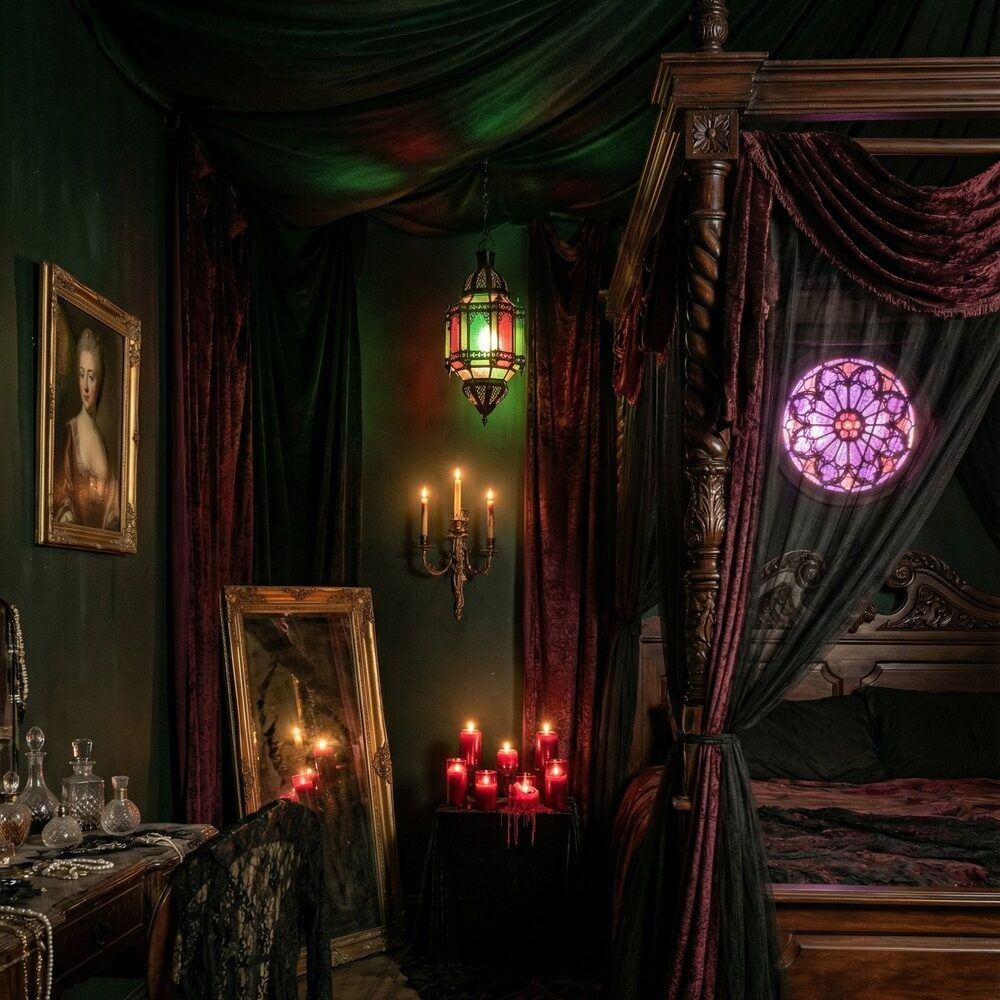
The vampire romantic vanity is not a makeup table. It is a [dark wood dressing table with a baroque framed mirror above it, covered in the evidence of a particular kind of life. Crystal perfume decanters in varying sizes. A pearl necklace draped across a tray. A dark lace table runner beneath everything. A single [brass candelabra to the left of the mirror. A velvet jewellery box with the lid left slightly open.
The mirror above the vanity should be large enough to reflect the entire room behind it. Baroque frames, dark wood or aged gold, the kind of mirror that makes the room look twice as deep. Position it so that what it reflects includes at least one portrait and at least one lamp. The reflection should be as interesting as the surface it faces.
8. Books are furniture
In a room occupied since 1742 the bookshelves ran out of space during the Napoleonic Wars and the books have been finding their own arrangements ever since. Stacked on the floor beside the sofa. Piled on the coffee table beneath the decanter. Lined along the windowsill between the lamps. Two stacked on the side table as a riser for the candelabra.
Dark leather-bound hardcover books in burgundy, black, dark green, and gold — the kind that look like they contain something specific and important — are the right choice for visible stacks. Field guides, atlases, volumes of poetry, anything with a spine that suggests it has been read rather than displayed. Stack them in groups of three or four at different heights. Leave one open. Leave one face-down. The books in a vampire romantic room are in the middle of being read, not waiting to be read.
9. The objects on every surface tell a story
A room occupied for centuries accumulates objects the way sediment accumulates — slowly, in layers, each one added on top of what was already there until the surface history becomes impossible to read in a single sitting. On the side table: a small bronze or brass hourglass, a magnifying glass with a brass handle, a wax seal kit, and a stack of letters that may or may not be recent. On the windowsill: crystal decanters catching the lamplight. On the mantel: a clock, two candles, a classical bust, and something that raises a question.
The rule is that every surface should have at least three objects on it and at least one of those objects should prompt a question from anyone who notices it. What is the compass for. Whose portrait is that. What is in the decanter. The room should feel like the beginning of a conversation that will take the whole evening to finish.
10. The walls are near-black and the ceiling follows
The wall colour in a vampire romantic room is the decision that makes every other decision possible. Near-black, deep charcoal, dark navy, forest green so deep it reads as black in lamplight — any of these work. What doesn’t work is a light wall. A light wall makes the gilt frames float. A dark wall makes them belong.
Paint the ceiling the same colour or one shade darker. A white ceiling in a near-black room is an architectural mistake that no amount of layered lighting can fully correct. The room should feel enclosed — like the darkness is structural, not decorative. Like it was always this dark in here and always will be.
The Art on the Walls: Portraits of People You May or May Not Have Known
The portraits in a vampire romantic room are doing the heaviest atmospheric work of any object on the wall. They suggest a specific kind of history — one where the person who hung them knew the subjects, or at least wanted visitors to wonder if they did.
Every portrait in a room like this should be painted in the manner of someone who sat for it. Franz Xaver Winterhalter painted the formal portraits of European nobility in exactly this register — women in elaborate gowns, men in military dress, expressions that suggest a great deal is being left unsaid. His work is entirely public domain. A Winterhalter portrait printed at 24×30 and placed in an ornate gilt frame is indistinguishable from an inherited original at the distance of a room.
John Singer Sargent’s portraits have a different quality — looser, more psychological, the kind of painting that makes you feel the subject is still thinking about something that happened before you walked in. His work is also entirely public domain and works particularly well in oval frames or smaller formats, as though they were commissioned for a locket and ended up on a wall through a series of decisions no one can fully account for.
A set of Victorian portrait prints in gilt and dark frames of varying sizes, hung without a grid and at slightly inconsistent heights, is where the wall begins. Add the botanical prints and the antique map afterward. The portraits are the reason the wall has a history. Everything else is evidence.
How To Start
Start with the lamps. Buy three before you buy anything else. Position them — one floor lamp, two table lamps — and turn off the overhead light. Sit in the room for an evening. The room will already feel different and you haven’t changed a single permanent thing.
Buy the curtains second. Floor-length, heavy, in a colour that absorbs light rather than reflecting it. Hang them high — at ceiling height if possible — and let them pool slightly on the floor. The room will change again.
Paint the walls third. Near-black or deep charcoal or forest green so dark it reads as black in lamplight. This is the commitment that makes everything that follows feel inevitable rather than assembled.
Everything after that — the sofa, the rug, the portraits, the objects — is accumulation. Add things slowly. Let each one find its place. A room that looks like it has been occupied since 1742 was not decorated in an afternoon and it should not look like it was.