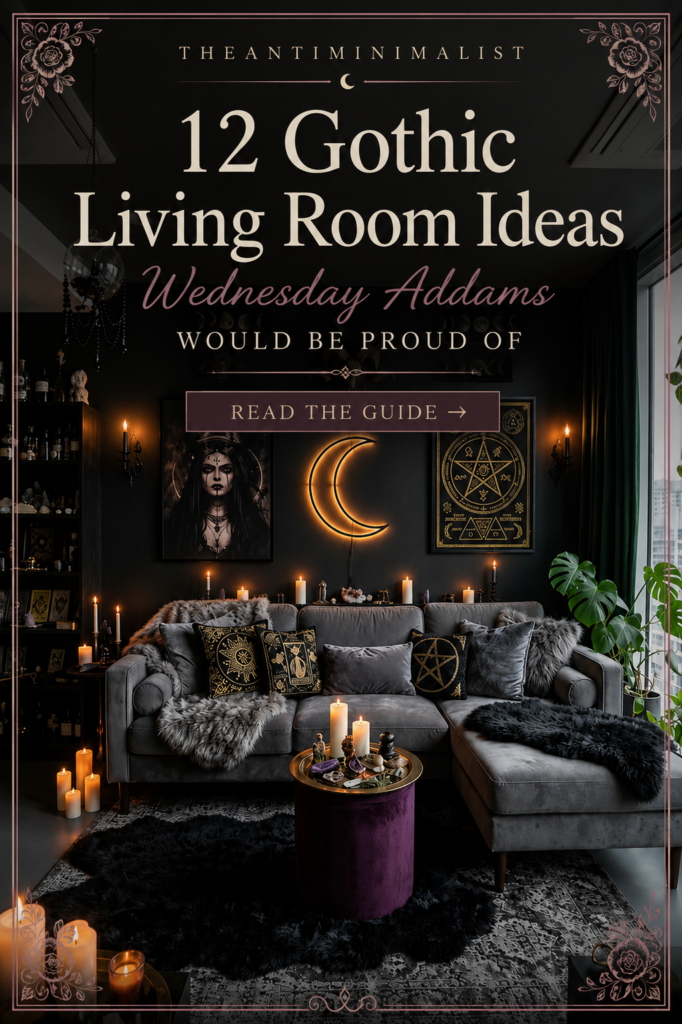
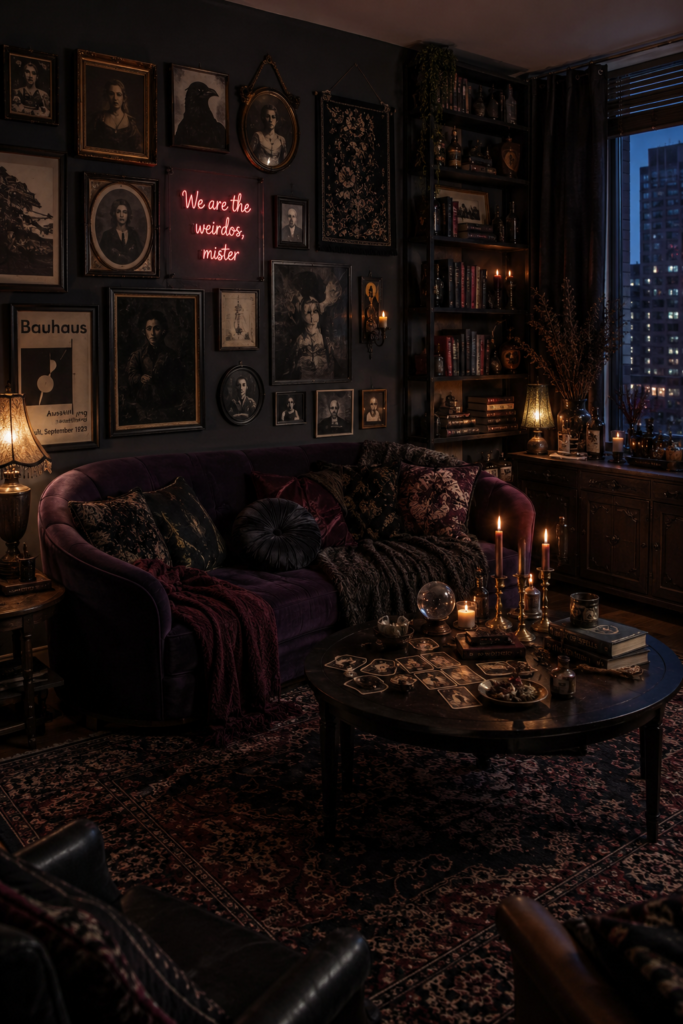
A gothic living room earns its register. It is dark, it is dramatic, it is unapologetic about being itself, and it is not interested in matching the rest of the building. The aesthetic crosses pure goth, vampire romantic, and witchcore-adjacent — what holds it together is a small list of consistent moves: a black or deep purple Chesterfield, candlelight rather than overhead light, a chandelier with weight, and enough Victorian portraits on the wall to convince a guest the house came with them. The 12 ideas below are the exact products, in roughly the order to acquire them, that build the room Wednesday Addams would actually move into.
12 Gothic Living Room Ideas
1. Lay a Dark Persian Rug in Oxblood, Burgundy, and Black Across the Whole Floor
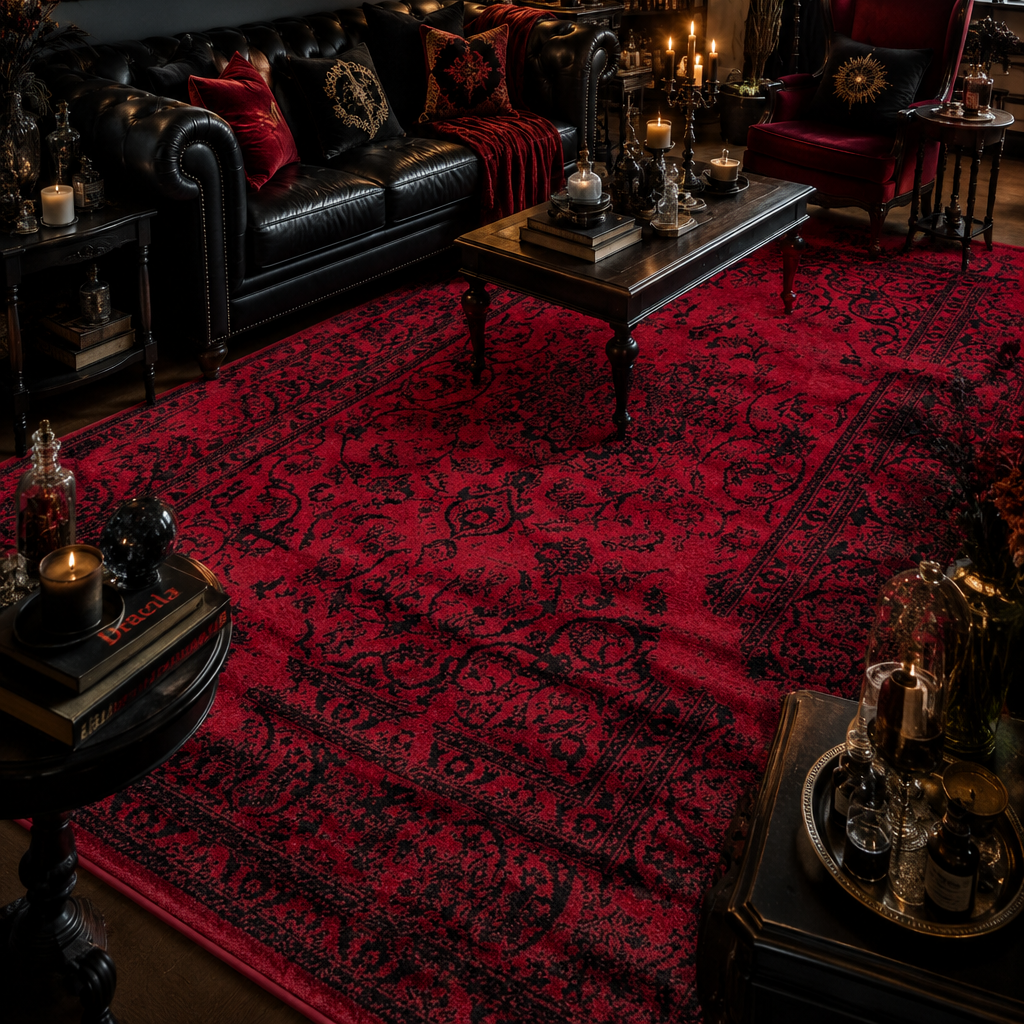
The rug sets the floor of the room and the color temperature of every object on top of it. A Persian in oxblood, deep burgundy, and black — large enough that the front legs of the sofa and the back legs of any armchair both land on it — anchors the room before any furniture decision is made. The dark tones absorb the candlelight rather than reflecting it back, which is the entire reason the goth living room reads more atmospheric than a brightly lit room with the same furniture. Buy the rug first. Every subsequent purchase will coordinate with it rather than fight it.
Copy this idea:

2. Anchor the Room With a Black Leather Chesterfield or a Deep Purple Velvet Tufted Sofa
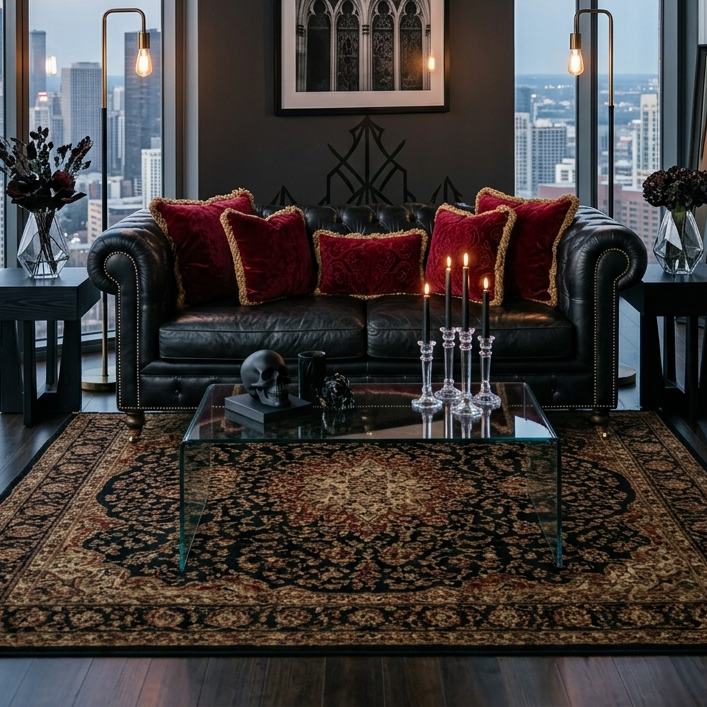
The sofa is the room. Two paths give you the same destination: a black leather Chesterfield with deep button tufting and brass nailhead trim runs harder into pure goth territory, while a deep purple velvet Chesterfield leans into vampire romantic. Both share the silhouette — low back, rolled arms, button tufting, and the kind of weight that makes the rest of the furniture answer to it. Layer the sofa with throw pillows in contrasting jewel tones: crimson velvet against the black leather, black damask against the purple velvet. The contrast pillows are what stop the sofa from disappearing into the dark wall behind it.
Copy this idea:


3. Hang a Black Crystal Chandelier Above the Seating Area
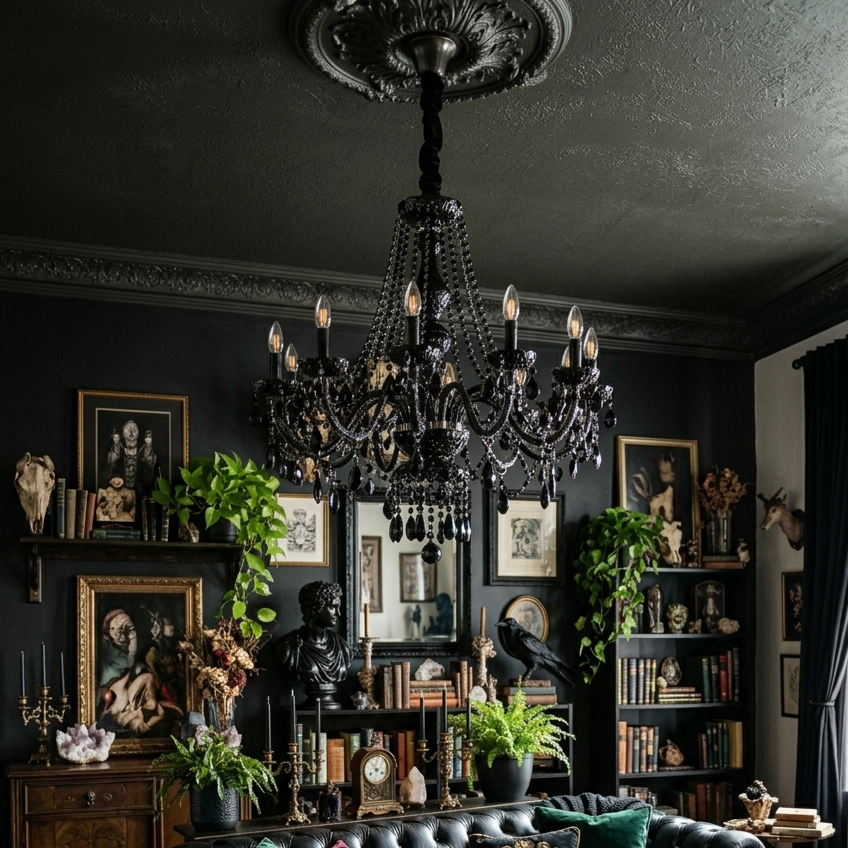
The black crystal chandelier is the gothic statement piece that no other lighting fixture can substitute for. Cascading black crystal drops, candle-style bulbs, and a finish in matte black or aged bronze — hung directly above the coffee table or centered over the seating area — turns the ceiling itself into part of the room’s decoration. Choose a fixture wide enough that it reads from across the room. Install it on a dimmer switch and run it at about 30% the entire time it’s on, so the candles on the coffee table can still do their work. The chandelier is for atmosphere, not illumination.
Copy this idea:

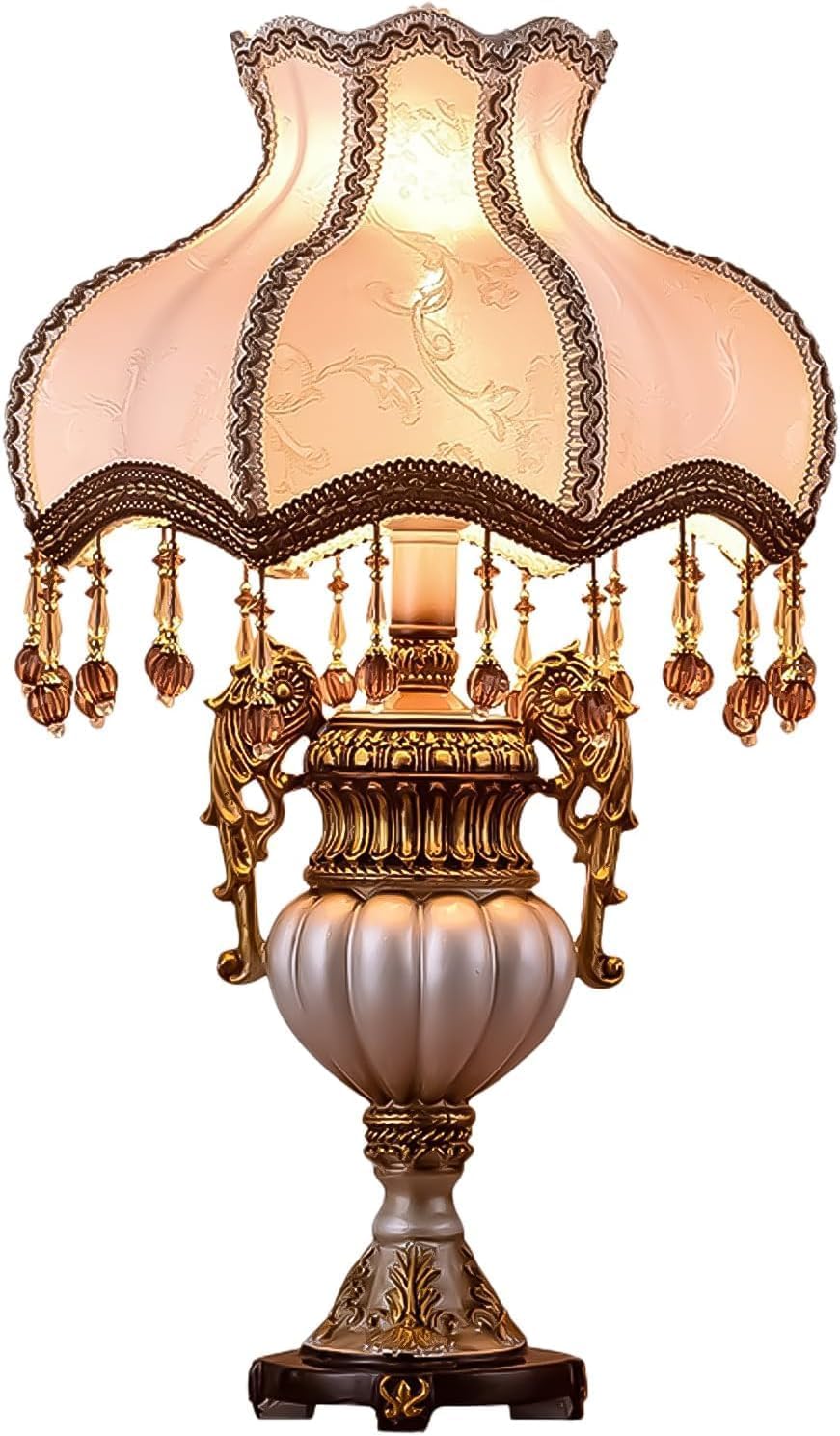
4. Add a Vintage Fringed Table Lamp For the Second Lighting Layer
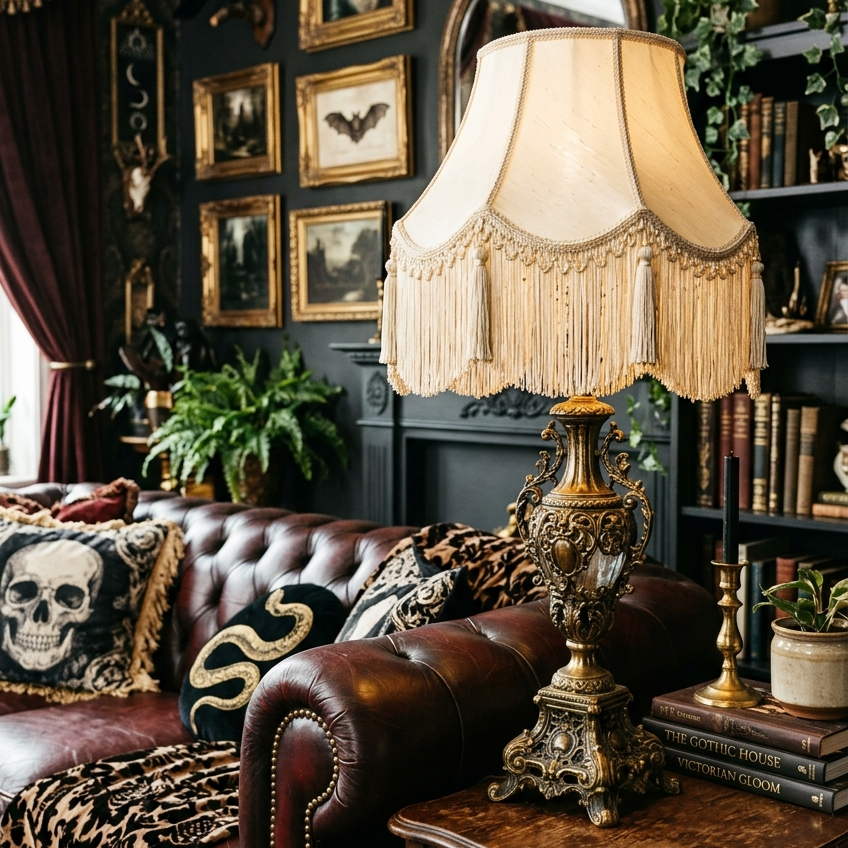
The fringed lamp is the most Victorian-coded piece of lighting in the gothic vocabulary, and the second light source the room needs after the chandelier. A bronze or aged brass base, a cream or burgundy silk shade with full fringe and tassel trim, placed on a side table beside the sofa, puts warm directional light exactly where the room reads as inhabited. Pair it with a 2700K warm bulb and use it as the primary task light for reading after dark. The fringe is the entire reason this lamp exists — synthetic modern reproductions don’t read the same. Look for one with real silk and a proper tassel.
Copy this idea:

5. Run Heavy Velvet Curtains in Black, Burgundy, or Deep Plum Floor to Ceiling
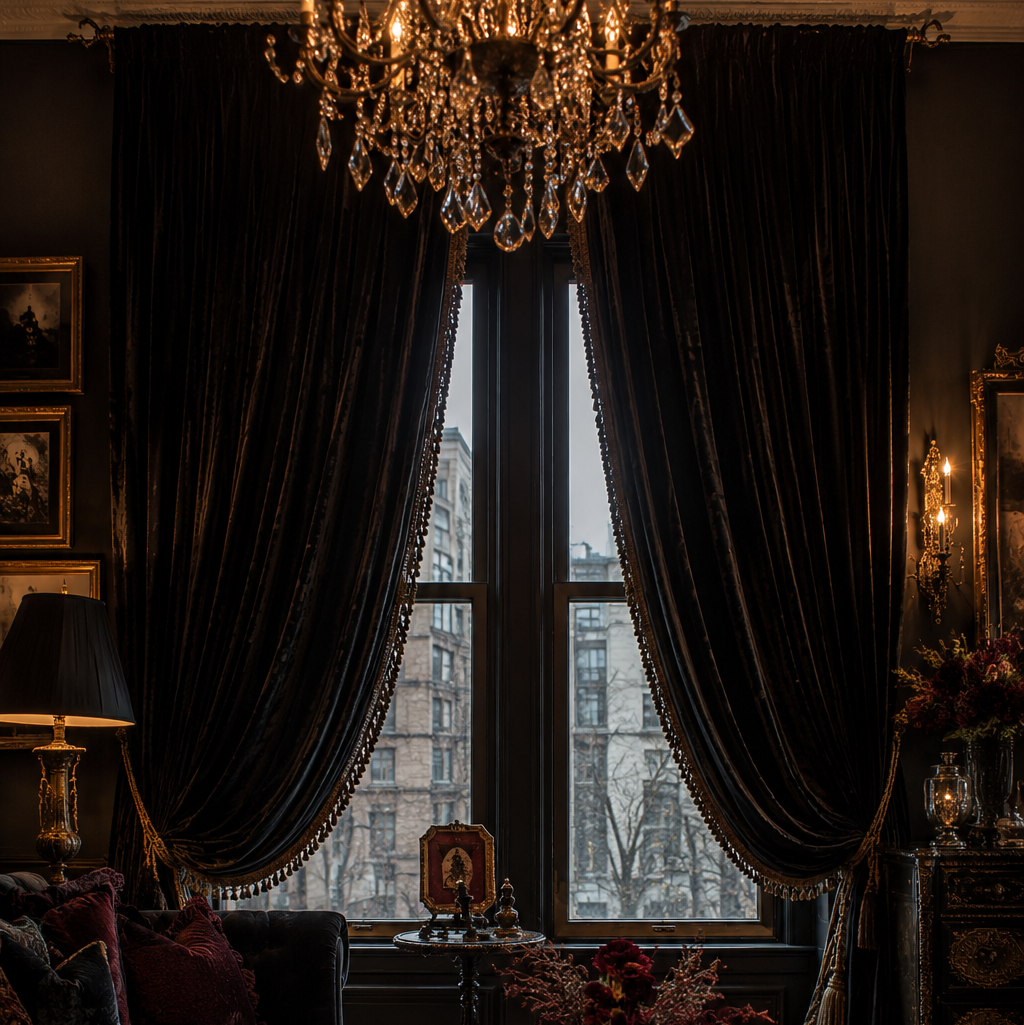
Mount the rod at the ceiling, not above the window frame. Run the curtains all the way to the floor — touching, not hovering. Choose a velvet heavy enough to block actual daylight: black velvet for the most graphic option, burgundy or deep plum if the rest of the room already runs heavily black. The windows in a gothic living room are not a feature to be highlighted. They are a fact to be managed, and the curtains are how you decide when natural light enters the room and when it doesn’t. Heavy velvet absorbs sound as well as light, which is the secondary benefit no one talks about.
Copy this idea:

6. Build a Gallery Wall of Victorian Portraits in Mismatched Gilt and Ornate Frames
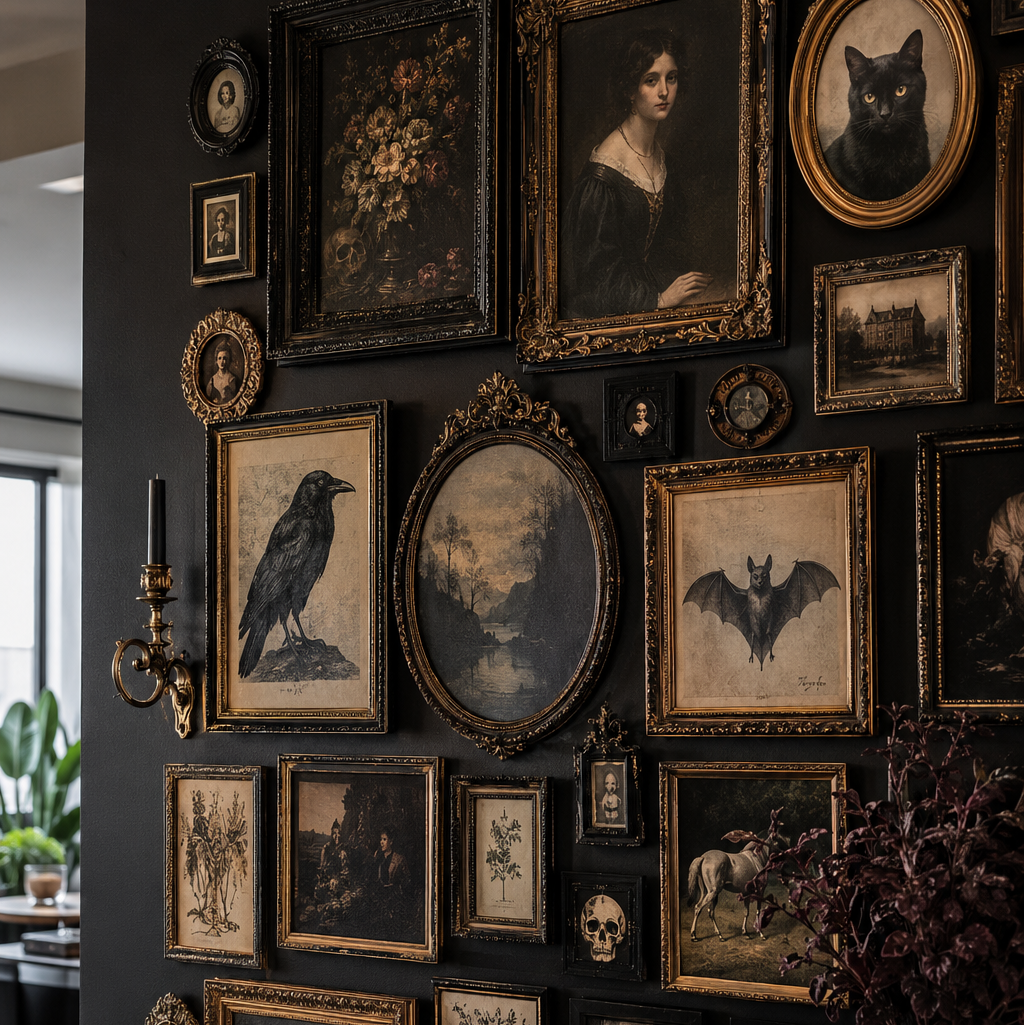
A wall of Victorian portrait prints — daguerreotype reproductions, oil portraits of unnamed sitters, a raven print or two, the occasional moody landscape — is the most distinctly gothic gallery wall available. The portraits should not be flattering. They should look like the wall arrived with the house and the inhabitants have never once felt strongly enough about it to take anything down. Print public domain portraits from Wikimedia Commons at A3 or larger. Frame them in mismatched ornate gilt, aged bronze, and dark wood — oval, rectangular, round, whatever turns up. The mismatch is the entire point.
Copy this idea:

7. Hang Celestial or Occult Art — Moon Phases, Tarot, or a Sigil Print Set
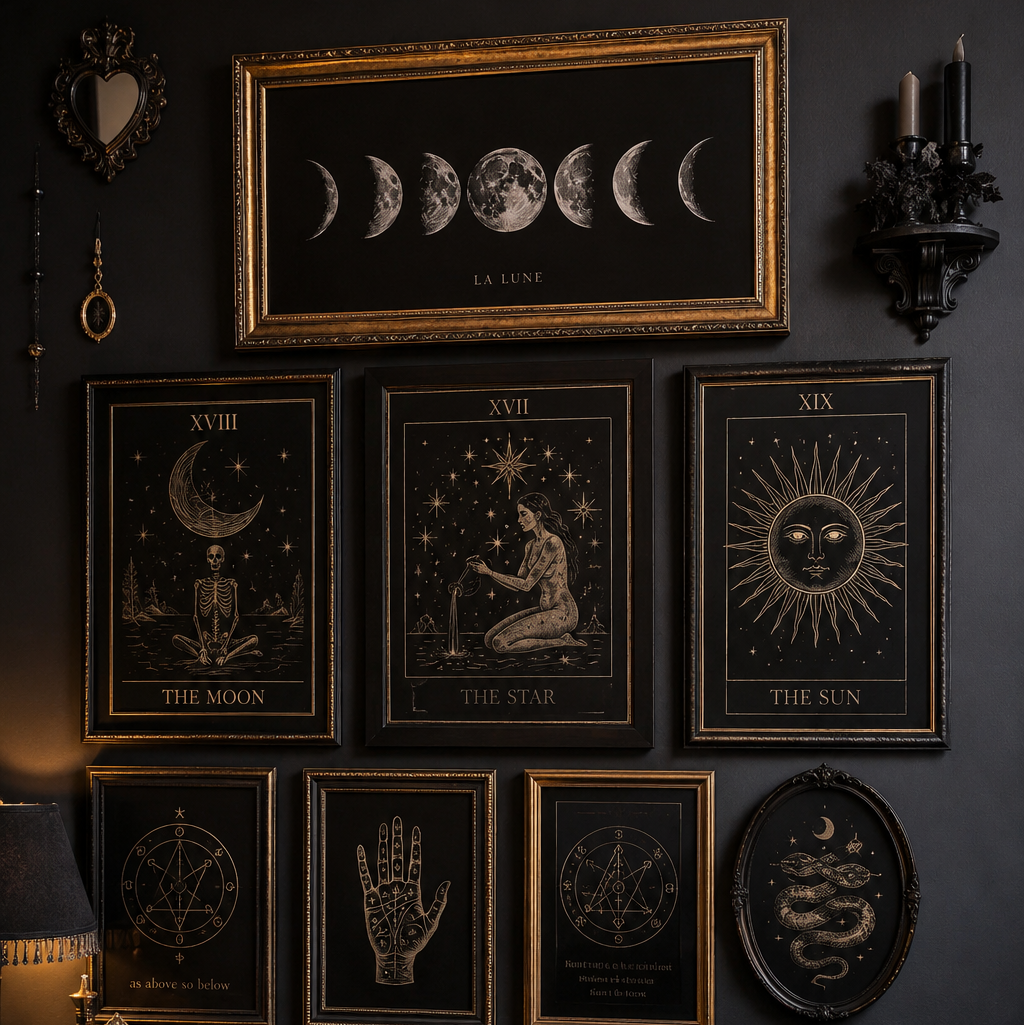
The wall opposite the portrait gallery asks for something celestial. A moon phase print set across one long wall, a single large pentagram or sigil print in a dark wood frame above the sofa, or a tarot card art print in a gilt oval — any of these adds the occult layer that separates a gothic living room from a vampire romantic one. The art doesn’t need to mean anything ritually to be in the room. The symbolism is the visual texture, and the room is allowed to wear it the same way it wears the velvet curtains. Pair celestial prints in a series; pair sigil prints alone, where they can carry the wall.
Copy this idea:


8. Mount a Custom Neon Sign — Crescent Moon, Pentagram, or Your Own Phrase
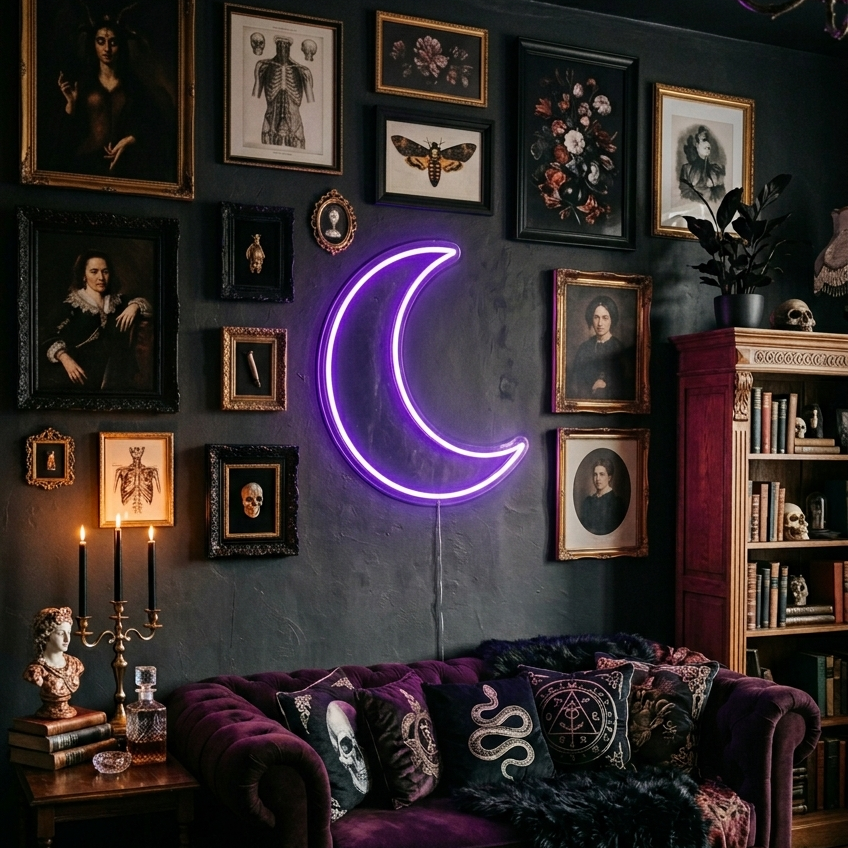
A neon sign is one of the few modern objects that reads as authentically gothic, partly because actual goth bars and venues have used neon for decades. For the a goth look, two paths lie ahead: a shaped symbol — a crescent moon, a pentagram, a small bat silhouette — or a custom text sign in your own phrase. Most custom neon retailers on Amazon let you specify the exact wording, the color of the light (pink, red, purple, and warm white are the goth-correct options), and the size. Whatever line you have been wanting to put on your wall, this is the room it belongs in. Mount it above the sofa or above the bookshelf so the colored light spills across the wall behind it after dark.
Now, actual neon is hard to come by and costly to make. It looks gorgeous, but the look can be easily recreated with custom LED signs off Amazon. It’s important to choose a good retailer, because the cheap ones look blotchy, cold, and dim. Not ideal. This one is my fav, because it’s brightness actually lends itself to a neon look.
Copy this idea:

9. Position an Ornate Carved Dark Wood Coffee Table as the Center of the Room
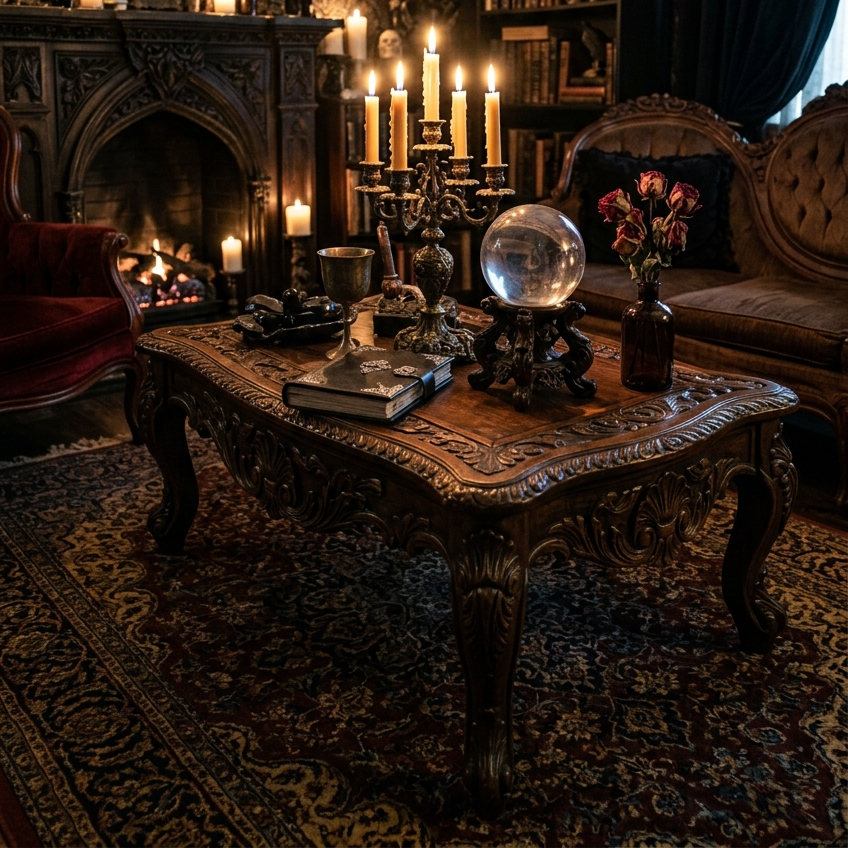
The coffee table in a gothic living room is not a flat surface — it is the altar of the room. A dark wood table with a carved baroque base, turned legs, and the kind of heft that makes you reconsider whether to move it once it’s in place, gives the center of the room an anchor that no IKEA table can match. Choose ebony, dark walnut, or mahogany. The surface should be wide enough to hold a candle cluster, a stack of books, a crystal ball, and a tray for tarot without crowding any of them. Iron hardware and feet are a bonus. Glass tops are out — the wood is the point.
Copy this idea:

10. Style the Coffee Table With a Crystal Ball, a Decorative Skull, and a Cluster of Brass Candlesticks
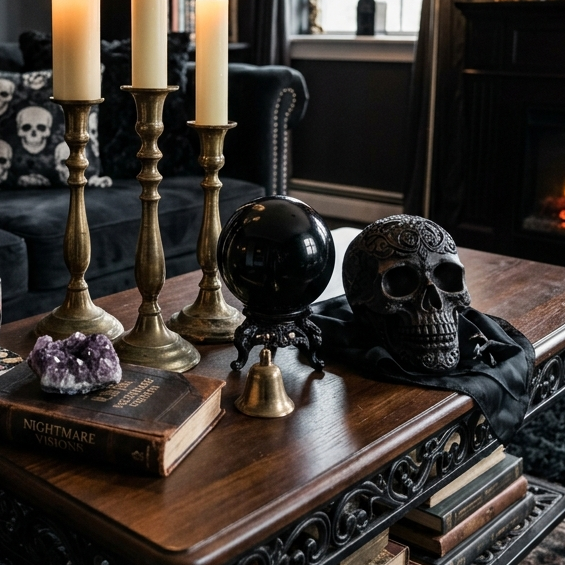
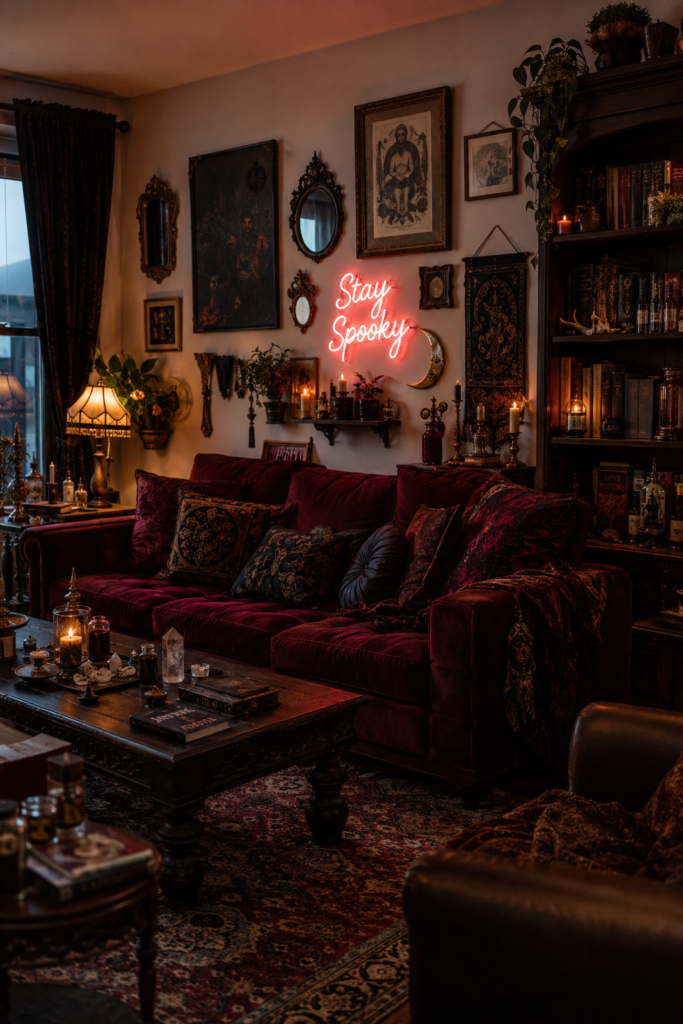
The coffee table styling is what separates a dark living room from a gothic one. Three objects working together. A crystal ball on a brass stand catches the candlelight and throws it across the table. A decorative skull — resin or stone, no ethical concerns — sits beside it as the gothic anchor that no other accessory replaces. A cluster of brass candlesticks at three or five varying heights, holding black or deep red taper candles, provides the working light for the table itself. Add a small wooden tray under the candlesticks to catch wax and to group the cluster visually. Light the candles every time the room is used after sundown.
Copy this idea:



11. Mount a Faux Ram Skull or Decorative Antler Display on the Statement Wall
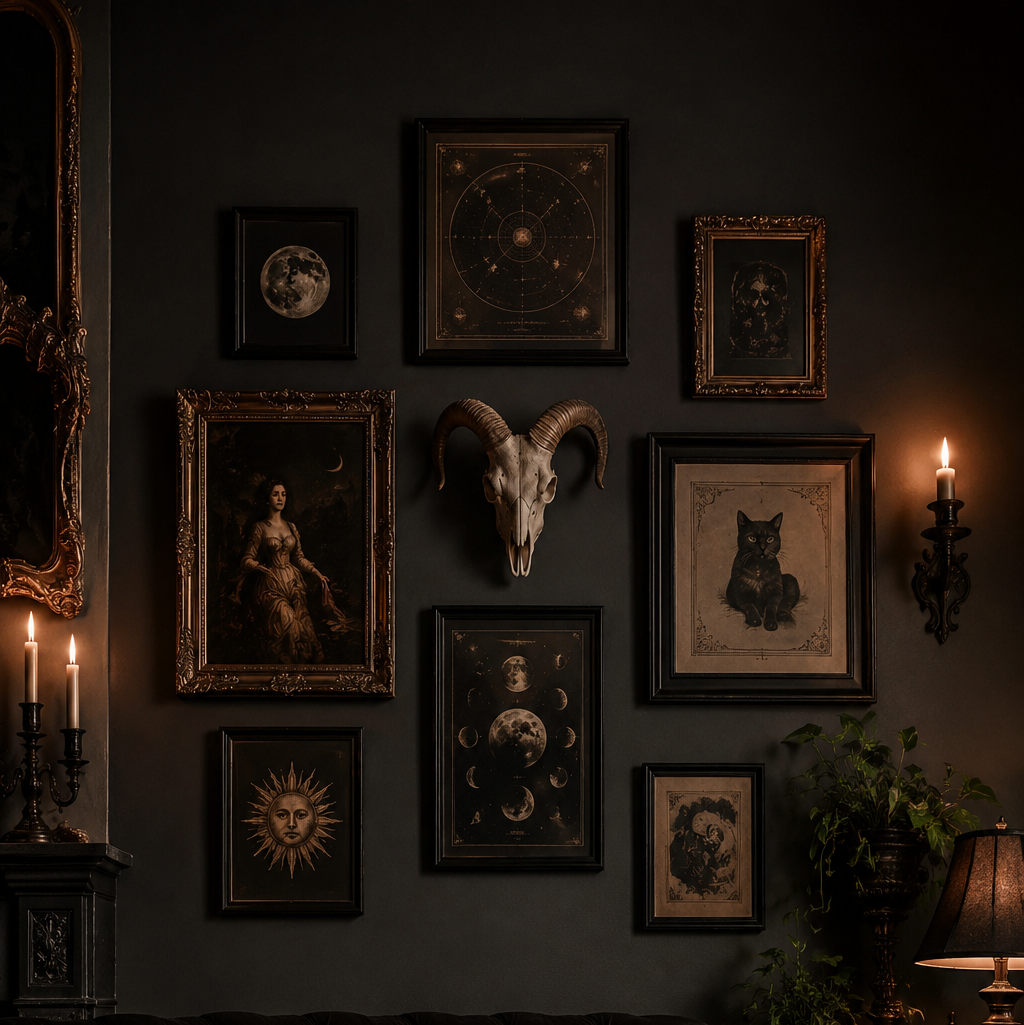
A ram skull or antler display on the wall above the sofa is the gothic equivalent of a hanging crucifix in a Spanish Colonial dining room — the single object that telegraphs the room’s entire register. Faux resin skulls are widely available, ethically uncomplicated, and indistinguishable from the real thing at five feet of distance. Mount it centered between the moon phase prints, or beside the gallery wall, on the wall that gets the most visitor attention. The skull works alone — it does not need to be flanked by additional decor on the same wall. The empty space around it is what makes it land.
Copy this idea:

12. Add a Crimson Velvet Tufted Ottoman or Side Chair as the One Pop of Color
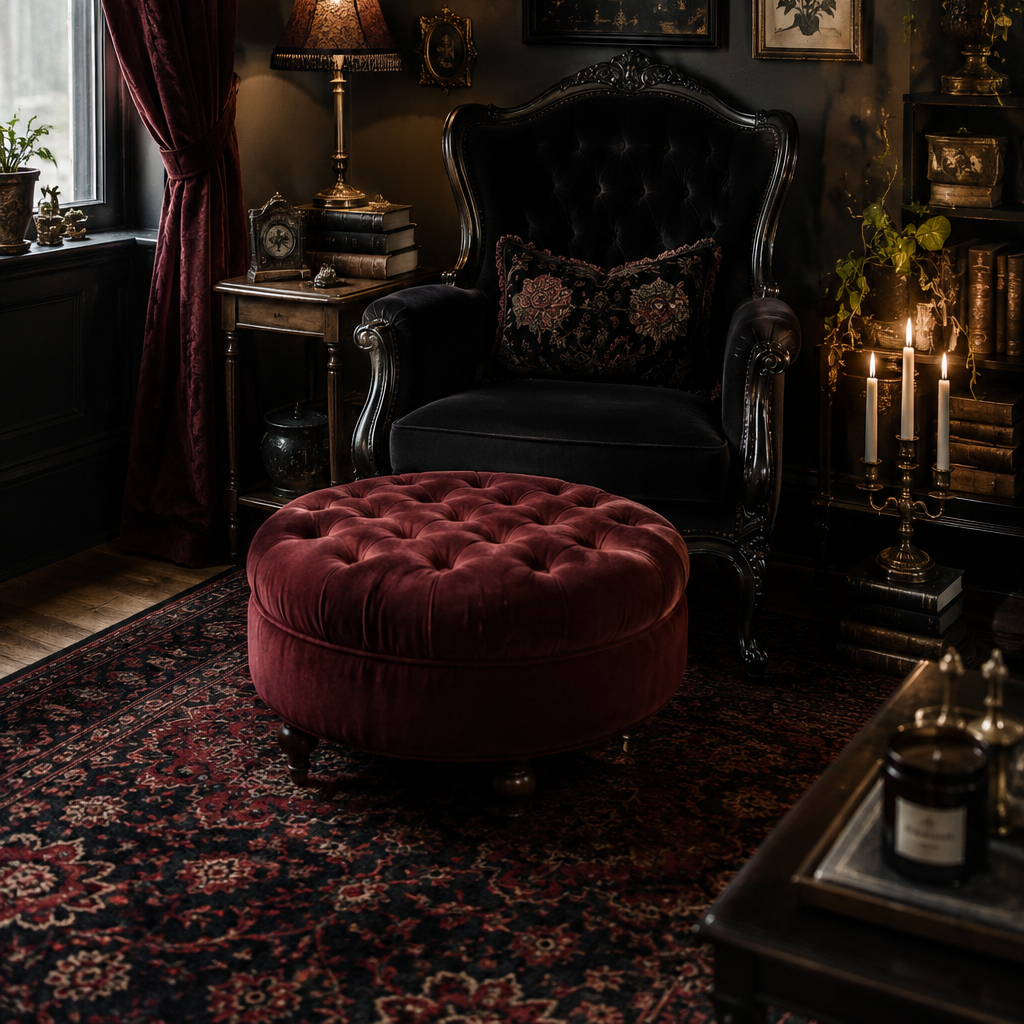
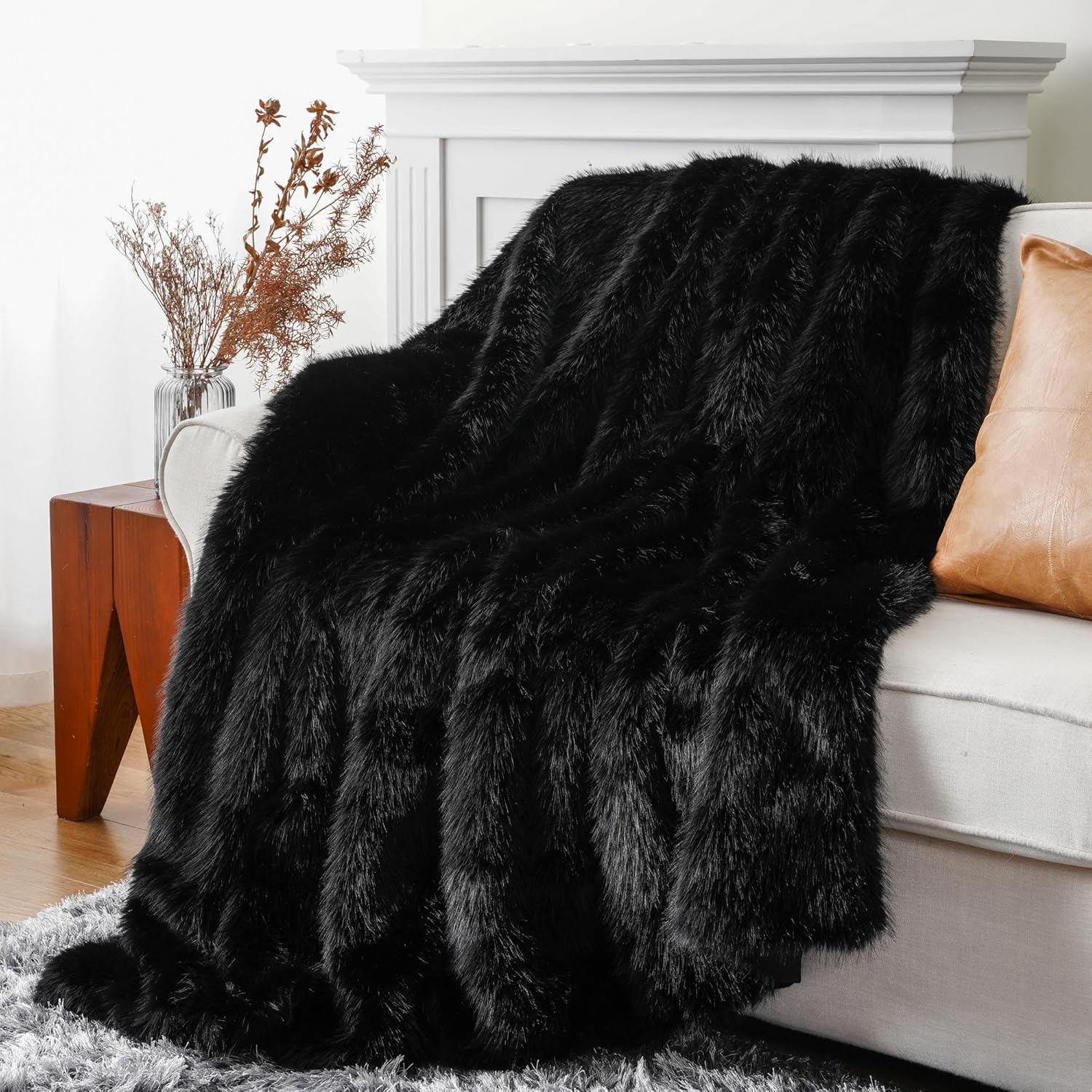
A room this dark needs exactly one place where the color saturates — a single crimson velvet element that the eye lands on and the rest of the palette frames. A tufted ottoman in deep red velvet pulled in front of the sofa works perfectly. A small velvet side chair in the same crimson does the same job. Pair it with a black faux fur throw draped over the back of the Chesterfield for the textural contrast that completes the seating arrangement. The single pop of crimson is what makes the rest of the dark register, not the other way around. Too many red elements scattered through the room and the contrast disappears.
Copy this idea:

Where To Start
The cheapest first moves are the ones that change the room fastest. If you’re building the gothic living room on a budget, the highest-leverage opening sequence is candle clusters with brass candlesticks, a black faux fur throw, a single celestial print, and a decorative skull on the coffee table — all under $40 each and all capable of visibly shifting an existing dark room into gothic territory before any furniture changes hands.
The chandelier and the sofa are the long-term anchors. Both are significant purchases and both are worth saving for. The black Chesterfield is the single most consequential furniture decision in the room, and the black crystal chandelier is the single most consequential lighting decision. Spend more here than you initially planned. Used Chesterfields turn up regularly on Facebook Marketplace and at estate sales, and the patina on real used leather is something new furniture cannot replicate.
Paint the walls before you order the curtains. Charcoal, near-black, deep plum, or oxblood — the exact color determines what the curtains need to do. Live with one painted wall for a week before committing to a full room of paint. The way a near-black wall reads in your specific light is impossible to predict from a swatch.
The custom neon sign is the easiest personalization point. It is the one object in the room where your specific phrase or symbol gives the room a personal stamp without committing to a permanent decision. Custom neons come down and go up as cleanly as a framed print, and a year from now you can swap the phrase entirely without changing anything else in the room.
Build the gallery wall last. The portrait wall and the celestial wall both work best when the rest of the room is already in place. You will hang them differently once you know exactly where the lamp falls, where the sofa sits, and where your eye lands first when you walk into the room. Wait. [Internal link: Dark Academia Living Room Ideas]