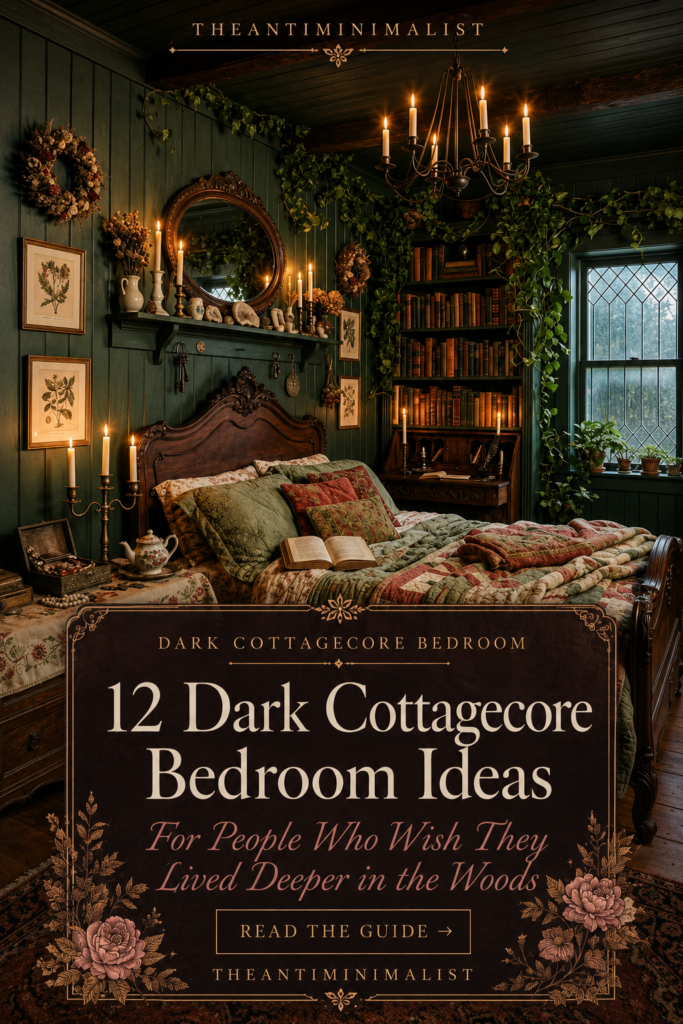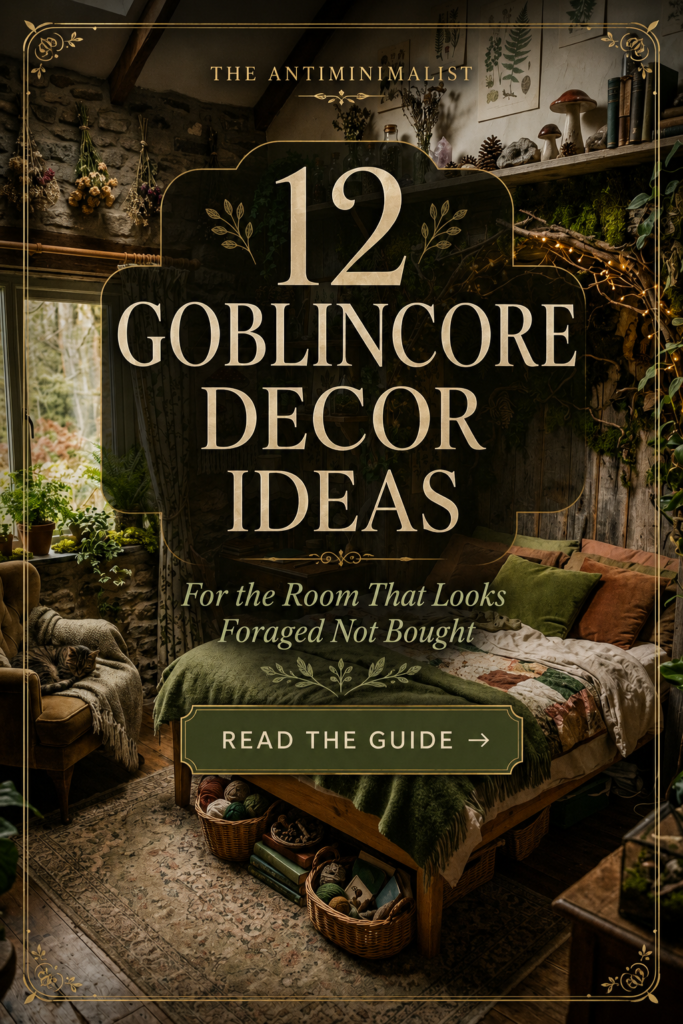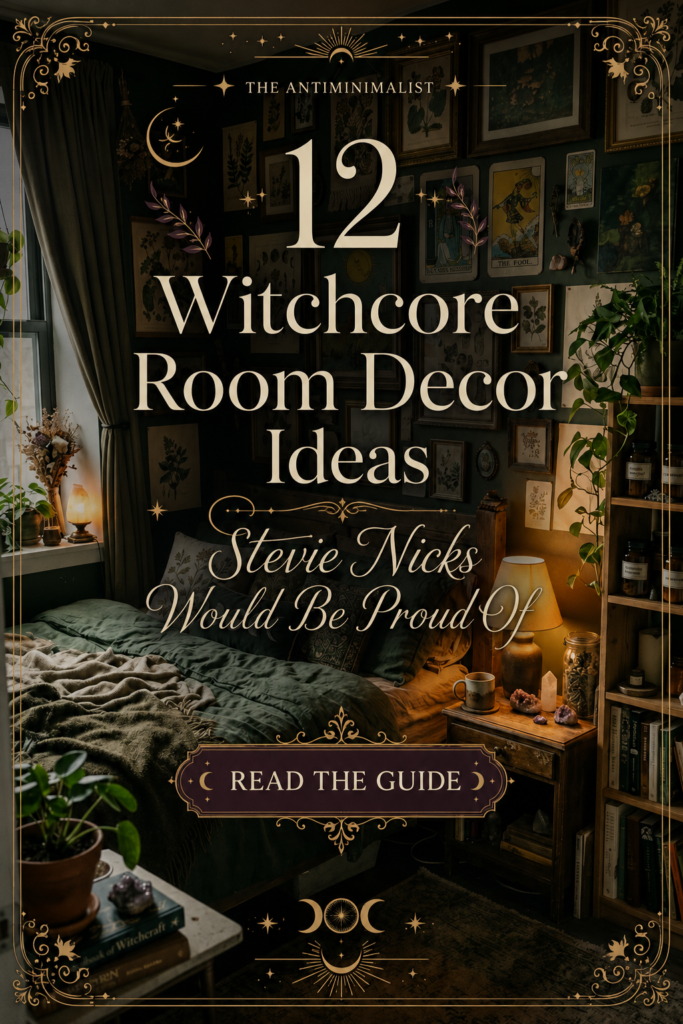
There is a specific kind of afternoon I have been trying to build a room around for years. Rain on the window. A book open face down on the cushion because something outside caught my attention for a moment. A cat asleep in the corner of the reading nook that has claimed it as permanently as I have. Three rugs layered on the floor because one was never going to be enough. Every lamp in the room on. A candle lit on the coffee table beside the stacked books and the ceramic mug that has gone slightly cold.
Dark bohemian is the aesthetic of that afternoon. Not the curated version of it — the real version, where the pillows are mismatched because they were bought at different times in different places and all of them were exactly right when they arrived. Where the gallery wall grew one frame at a time over several years and has never been measured or leveled. Where the bookshelves are organised by feeling rather than system and contain things that are not books at all — a small ceramic, a candle burned most of the way down, a plant that started on the top shelf and has been making its way toward the floor ever since.
This is how to build that room. Every layer, every textile, every surface that has something on it worth looking at on a rainy afternoon.
The Look
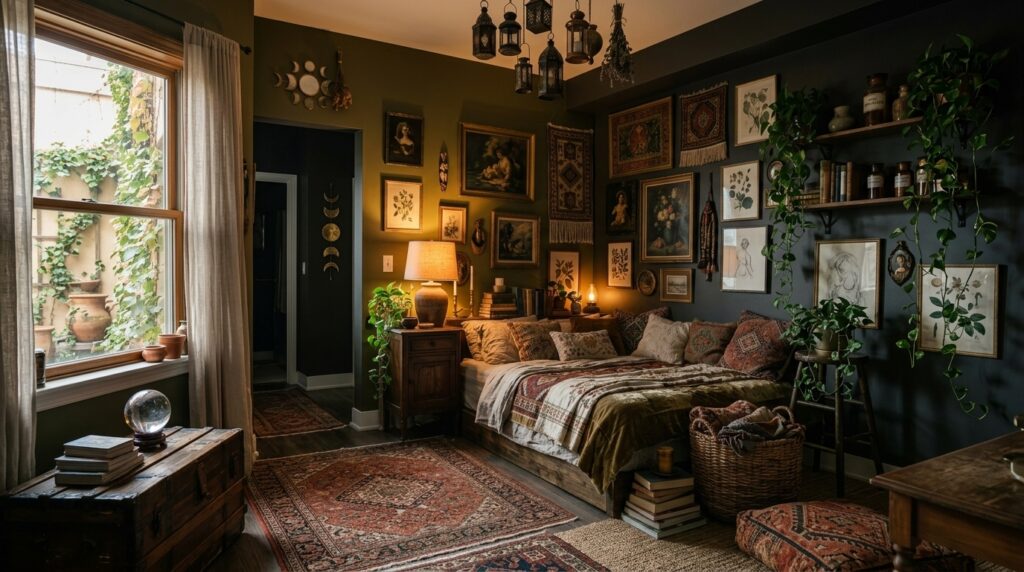
The walls are dark — deep olive, charcoal, forest green, the kind of colour that makes the room feel warm rather than cold when every lamp is on. The bed or the sofa or the reading nook — depending on which room this is — has more textiles on it than could be justified to anyone who asked. A patchwork quilt in earthy tones. A velvet throw in rust or burnt orange. Mixed embroidered ethnic throw pillows in patterns that do not coordinate and do not need to.
The gallery wall covers most of two walls — oil paintings in gilt frames, botanical prints, small woven tapestries, a macramé hanging, a figurine mounted between two frames, a pencil sketch in a plain dark frame beside an ornate one. None of it was hung at the same time. All of it belongs.
On the floor: layered Persian rugs. Two at minimum. Three if the room allows. A jute or natural fibre rug underneath as the base, a Persian runner across the middle, a smaller patterned rug at an angle in the corner where the reading nook is. The floor should look like someone collected rugs before they had the floor space for all of them and found a way anyway.
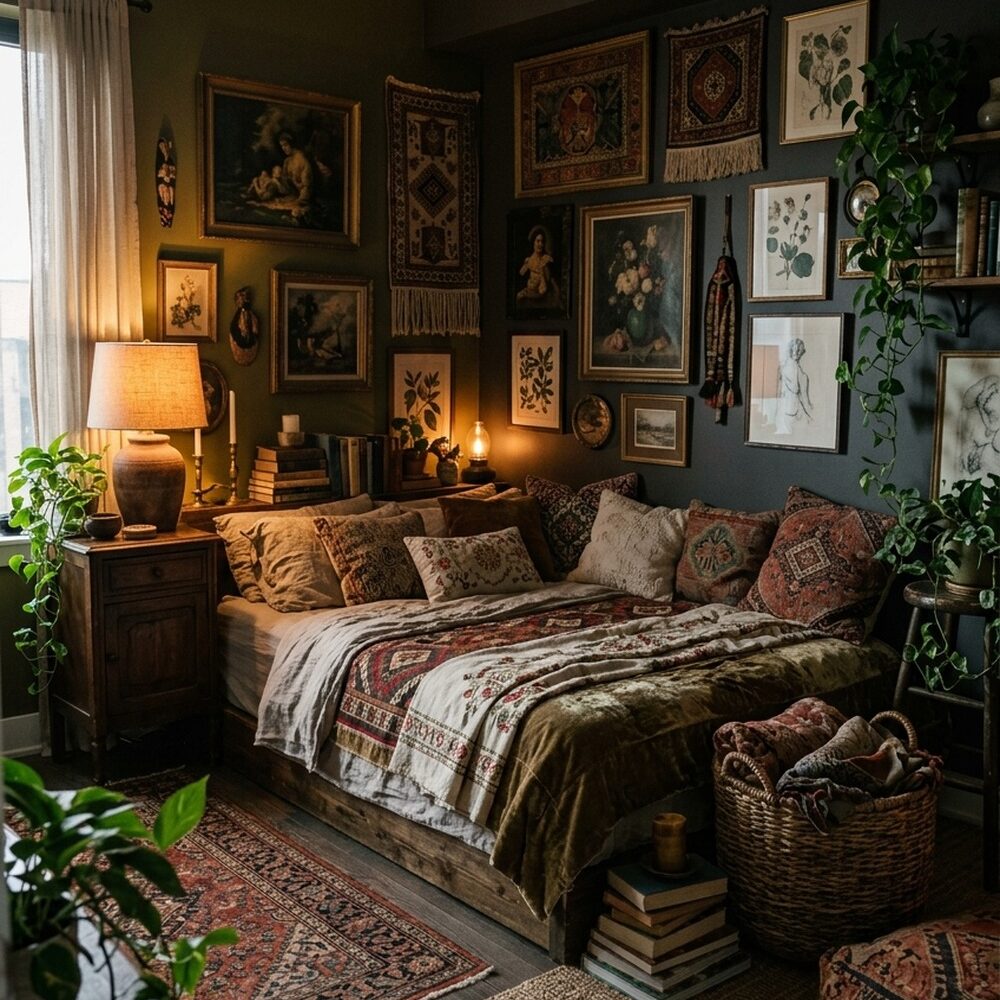
[HERO IMAGE — Image 1, dark bohemian bedroom, gallery wall, layered rugs, platform bed]
10 Dark Bohemian Room Decor Ideas
1. The walls go dark and the gallery fills them completely
Dark bohemian requires a dark wall. Not because the aesthetic demands drama — though it does — but because a gallery wall of oil paintings, botanical prints, and woven tapestries in mismatched frames reads entirely differently against a deep olive or charcoal wall than against a light one. Against a light wall the frames float. Against a dark wall they belong.
The gallery itself is built over time rather than assembled at once. The first piece goes up — a large oil painting in a gilt frame, or a botanical print, or a small woven tapestry — and everything else is added around it at intervals as the right thing comes along. The wall should look like it has been accumulating for years because eventually it will have been.
A dark olive or charcoal peel-and-stick wallpaper gives renters the same effect without a lease conversation. One wall behind the bed or sofa changes the room completely. Four walls changes who you are when you walk into it.
2. Layer the rugs before you buy anything else
The dark bohemian buyer buys the rug before the furniture. Often literally. The rug is the foundation of the room — the thing that establishes the colour palette, the pattern language, and the mood that everything else responds to.
A Persian-style area rug in rust, burgundy, and navy in the 8×10 range as the base layer. A smaller ethnic or kilim runner placed at an angle across it — not parallel, not centered, at an angle that suggests it arrived from somewhere else and found its position organically. A jute or natural fibre rug visible at the edges where the Persian doesn’t reach. Three rugs. The floor becomes a surface worth looking at.
The layered rug is the most photographed element in dark bohemian interiors and the most immediately recognisable signal of the aesthetic. It is also the highest-commission affiliate opportunity in this post — a Persian rug in the 8×10 range is where the economics of dark bohemian content are made.
3. The gallery wall has no system and that is the system
Every dark bohemian gallery wall looks like it grew rather than was arranged. This is not an accident — it is the result of a specific approach to hanging that prioritises accumulation over coordination.
Start with one large piece — a framed oil painting reproduction in the 20×24 range or larger, in a gilt or dark wood frame. Hang it slightly left of center on the main wall at eye height. Add the next piece — a small woven textile or tapestry hung directly on the wall without a frame — above and to the right. Then a botanical print in a mismatched frame below and to the left. A macramé wall hanging in the corner where the two walls meet. A small ceramic wall plaque tucked between two frames.
Nothing is measured. Nothing is leveled more than approximately. The wall looks the way it looks because someone was paying attention to what felt right rather than what looked symmetrical.
4. The reading nook is the room’s most important decision
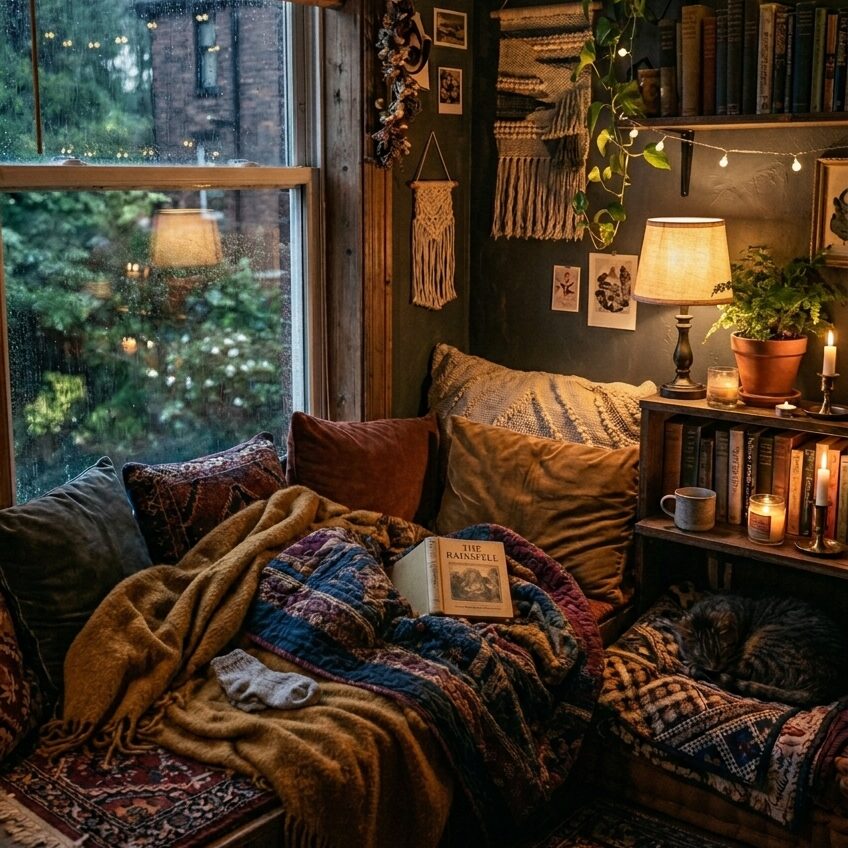
Every dark bohemian room has a reading nook — a corner, a window seat, a section of floor — that has been claimed for the specific purpose of being in on a rainy afternoon with a book and something warm to drink.
The floor version: a large floor cushion or meditation pillow in the corner by the window, layered with a Persian rug underneath and a patchwork quilt across it. Mixed throw pillows stacked against the wall. A small dark wood side table or crate beside it with a lamp, a candle, and a mug. A dark wood floating shelf above it with books and a trailing plant.
The window version: a window seat cushion in a rich fabric — velvet or kilim — with bolster pillows at either end. Layered throws. The window should have wooden blinds that filter rather than block the light, so on a rainy afternoon the room is dim but not dark, and the lamp on the shelf beside it is what makes the difference.
5. Every lamp counts
Dark bohemian lighting is plural. Not one lamp in the corner — every lamp in the room on simultaneously. A ceramic table lamp with a warm fabric shade on the nightstand. A dark wood or brass floor lamp behind the reading chair. A small accent lamp on the shelf among the books. Warm string fairy lights along the shelf edge or window frame. Candles on the coffee table and the windowsill.
The combined effect of multiple warm light sources at different heights is the thing that makes a dark bohemian room feel the way it feels on a rainy afternoon — enclosed, warm, lit from within rather than overhead. The overhead light is not on. It may never be on in this room and that is correct.
6. The textiles are the architecture
In a dark bohemian bedroom the textiles are doing the structural work that the furniture is not doing. The bed is covered rather than made. A patchwork quilt in earthy florals as the main layer — the kind with four or five distinct fabric patterns in it none of which were chosen to coordinate. A velvet throw in burnt orange or deep rust across the foot. A cable knit wool throw draped over the reading chair or the corner of the bed. Embroidered ethnic pillows in varying sizes stacked against the headboard.
The bed should look like someone is in the middle of a long afternoon in it. The throws are not folded. The pillows are not arranged. The book is face down on the quilt because someone got up to make tea and will be back.
7. The bookshelf is organised by feeling
The dark bohemian bookshelf is floor-to-ceiling and packed completely — no empty shelf space, no decorative gaps, no books arranged by colour or height. Books organised by feeling: the ones read most recently at eye level, the ones read so many times the spines are broken on the shelf at hand height, the ones kept because they were given by specific people on a shelf that requires a step to reach.
Between the books: a brass candlestick with a burned-down taper. A small dark ceramic vase. A trailing pothos that started somewhere at the top and has been growing toward the window for months. A small framed photograph or print tucked between two stacks. A decorative box whose contents are not immediately obvious.
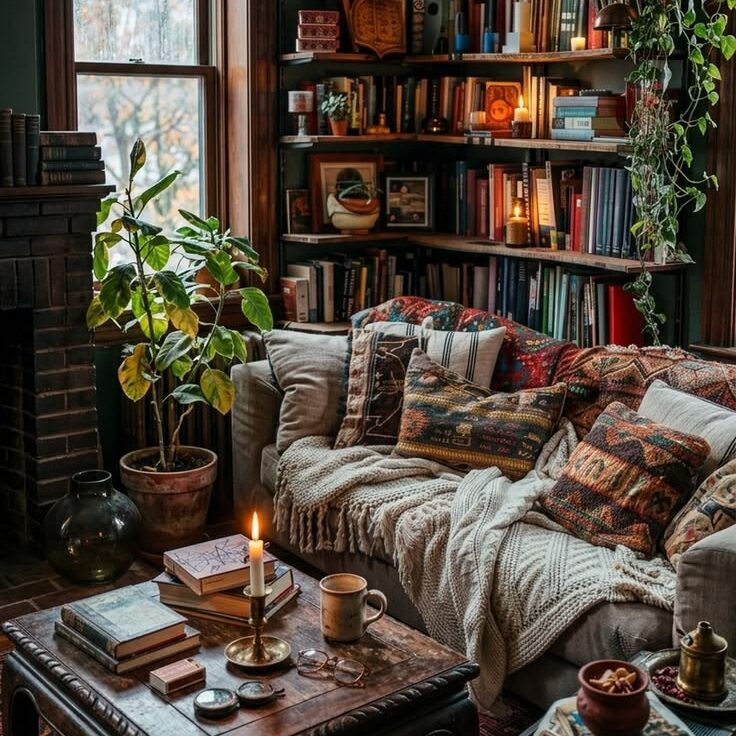
A floor-to-ceiling dark wood bookshelf unit positioned in the corner where two walls meet gives you a wrap-around library effect without built-ins. Position a large fiddle leaf fig or rubber plant in a terracotta pot beside it on the floor. The plant and the shelf together fill the corner completely.
8. The coffee table is a still life
The dark bohemian coffee table is never empty and never styled. It is covered in the things that were set down during the last few hours and have not yet found their way elsewhere. An open book face down on a stack of three others. A brass candlestick with a lit taper. A ceramic mug with something warm inside it. A brass compass that has been on this table long enough to be invisible. A small ceramic bowl with a few things in it — keys, a crystal, something from outside.
The dark wood coffee table itself should be substantial — solid wood, slightly low, the kind with enough surface area to hold all of this and still leave room to set a tray. Scarred or worn surfaces are correct. A table that looks like it has been a table for a long time looks right in this room in a way that a new table does not.
9. The plants are growing without supervision
Dark bohemian plants are not arranged. They are growing — trailing from shelves, hanging from ceiling hooks, climbing toward the window, spilling out of pots that have become too small and will be repotted eventually. The room has more plants than was originally planned and this is not a problem.
A large trailing pothos in a dark ceramic pot on the top shelf, trailing down over the books. A hanging pothos or ivy in a wicker or macramé hanger from a ceiling hook in the corner. A fiddle leaf fig or rubber plant in a terracotta pot on the floor beside the bookshelf. Smaller trailing plants on the windowsill among the candles and the books.
The plants in a dark bohemian room are the element that prevents it from feeling like a museum. They are alive and growing and slightly out of control and that is exactly the point.
10. The altar shelf above the bed
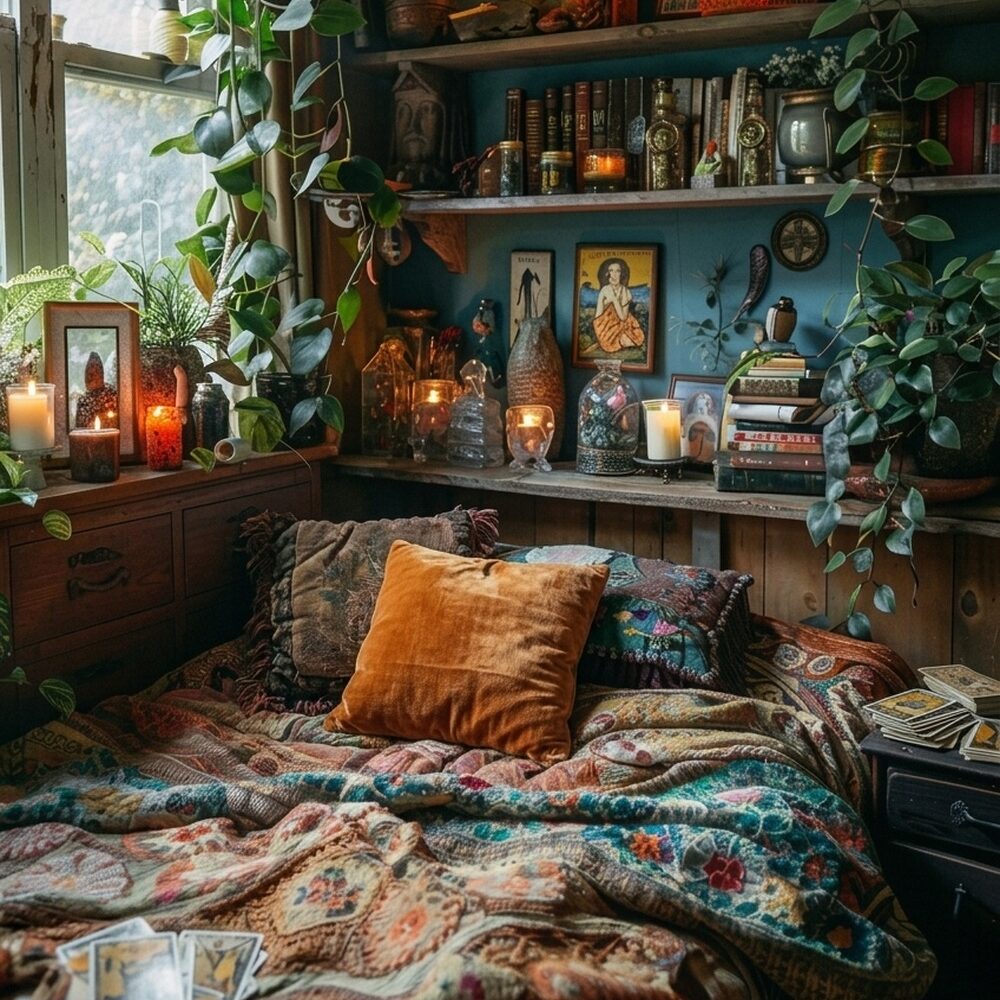
The shelf directly above the bed in a dark bohemian bedroom — positioned at the height of a tall headboard, running the full width of the bed — is the room’s most concentrated surface. It holds everything that belongs close to where you sleep: glass bottles with things in them, a candle in a glass holder, a small framed tarot print, a crystal or two, a small ceramic figurine, a trailing plant that has started making its way down the wall toward the pillow.
The shelf above the bed is the witchy edge of dark bohemian — the detail that separates it from dark maximalism and connects it to the witchcore and cottagecore aesthetics it sits beside. It is also the most pinnable detail in the bedroom because it photographs well as a close crop and contains five or six individually shoppable objects in a single frame.
The Rainy Afternoon Checklist
The dark bohemian room is built for a specific kind of use. Here is what it needs to do that well.
The lamp situation must be sorted first. A room that relies on overhead lighting will never feel like a rainy afternoon regardless of what else is in it. Three lamps minimum — one at the reading nook, one on the nightstand or beside the sofa, one on the shelf. Add the candles. Turn the overhead light off. The room immediately becomes a different kind of place.
The reading nook must have a designated spot. Even in a small room there is a corner, a window, a section of floor that wants to be the reading corner. Claim it. Put the cushion there. Put the lamp there. Put the small table with the mug-sized surface there. Once it is claimed it becomes the place and every rainy afternoon after that has somewhere to go.
The textiles must be out, not stored. The throws that get folded away in a basket are not doing the work. The throws that live on the reading chair and the end of the bed and the back of the sofa are doing the work. A dark bohemian room has throws on every soft surface because those surfaces are used that way regularly. If you are folding the throw and putting it away at the end of the evening the room has not finished becoming what it is trying to become.
How To Start
Buy the rug first. This is always the correct answer in dark bohemian. The rug establishes the colour palette, the pattern register, and the mood that every other decision responds to. A Persian rug in rust, burgundy, and navy in whatever size fits the room — even if it is not the final size, even if you will add a second one later — changes the room before anything else is moved.
Paint the walls second. Dark olive, charcoal, forest green. One weekend and the room becomes a different kind of room entirely.
Add the first lamp and the first throw third. Turn the overhead light off. Sit in the room for an afternoon and see what it tells you it needs next.
The gallery wall, the bookshelf, the reading nook, the plants — all of these come over time. The dark bohemian room does not arrive all at once. It accumulates the way every good thing accumulates — slowly, with intention, one right object at a time.