
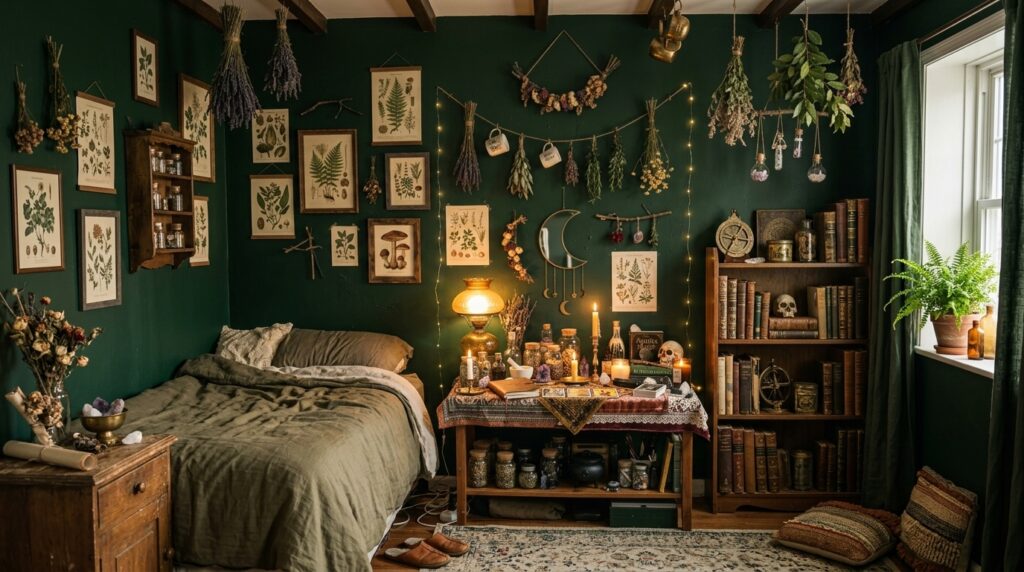
I do not trust empty shelves. An empty shelf is a surface that has not yet decided what it is. A shelf that has decided looks like this: dried herb bundles hanging from the bracket, a row of glass apothecary bottles at the back in graduating heights, a brass candlestick with wax down the sides, a raw amethyst cluster, a small resin skull, a mortar and pestle that has been used this week, an open book with marginalia, and a trailing pothos that started at the top and has been making its way toward the floor for the past several months. Every object on that shelf is there for a reason. The shelf knows what it is.
Witchcore is the aesthetic of a room that has a practice. Not a theme — a practice. The herbs are drying because they will be used. The candles are lit because the ritual requires them. The tarot cards are out because someone has been reading them. The crystal ball catches the lamp light and scatters it across the dark walls not because it was placed for effect but because it lives there and has for years.
This is how to build that room. Every object on every surface, every wall with something that means something, nothing empty, nothing without a reason.
The Look
The walls are deep — forest green, near-black charcoal, dark teal — the color of somewhere the light reaches slowly and amber. Every surface has something on it. The main shelf runs above the desk and holds the apothecary collection: glass bottles with cork lids in varying heights filled with dried botanicals, seeds, dark liquids, and things that do not need explaining. Dried herb bundles hang from the ceiling beam or the shelf bracket — lavender, sage, rosemary, mugwort — drying because they are being used, not because they were purchased as decoration.
The desk below the shelf has an open leather-bound journal with a brass candlestick to its left and a crystal ball on a brass stand to its right. The oil lamp provides the working light. On the walls: framed botanical illustrations, moth studies, moon phase prints, a celestial chart. None of it is arranged. All of it belongs.
The bedroom side of the room has a dark wood bed frame with layered dark textiles — velvet, patchwork, throws in forest green and deep purple and black. The Persian rug covers most of the floor. The plants are everywhere — trailing from shelves, hanging from ceiling hooks, growing in dark ceramic pots on every available surface. The room smells like dried herbs and candle wax and old books. It has been this way for a long time.
10 Witchcore Room Decor Ideas
1. The apothecary shelf is the room’s centre of gravity
Everything else in a witchcore room can be assembled over time. The apothecary shelf is the first commitment and the one that makes every other decision make sense. A dark wood floating shelf mounted above the desk at eye height when standing, loaded with the collection, lit from below by the desk lamp or a small [LED strip in warm amber](AMAZON AFFILIATE LINK) tucked along the bracket — this is the object that transforms a dark room into a witchcore room.
The objects on the shelf are not ornaments. They are inventory. Glass apothecary bottles with cork lids in three or four heights, filled with dried botanicals, seeds, raw herbs, and anything else worth storing in glass. A raw crystal specimen set — amethyst, obsidian, pyrite, rose quartz — positioned between the bottles. A decorative resin skull. A mortar and pestle in dark stone. A brass candlestick at one end with a taper burned most of the way down. The shelf should look like someone was just using it.
2. Every wall has something that means something
A witchcore room does not have accent walls. It has walls that are covered in things that were chosen for specific reasons — not to coordinate, not to fill space, but because each piece belongs to the person who hung it.
A moon phase print in a dark wood frame above the bed. A [vintage celestial star map beside the window. A cluster of botanical illustration prints in mismatched frames above the desk. A [framed moth or butterfly specimen between two candle sconces. A tarot card print — The Moon, The Star, The World — in a simple dark frame at eye height on the wall beside the door.
None of it needs to match. The wall is a document of a particular kind of attention — things noticed, things kept, things considered worth framing. Hang everything at slightly inconsistent heights. The wall that looks perfectly arranged looks arranged. The wall that looks accumulated looks inhabited.
3. The plants are not optional
Witchcore thrives on creating an eerie atmosphere filled with energy and magic, and the natural world is central to that — plants, herbs, and living things that suggest the room exists in active relationship with nature rather than sealed against it.
A trailing pothos in a [dark ceramic hanging planter at ceiling height, allowed to grow where it wants. A large Boston fern in a dark pot on the floor beside the bookshelf. A monstera in a dark glazed ceramic pot in the corner by the window. Smaller succulents and air plants on the windowsill among the crystals and bottles.
The plants in a witchcore room are not styled. They are growing. The trailing vine that has reached the bookshelf and started exploring the spines of the books is not a maintenance failure. It is the room doing what it should.
4. Dried herbs hang from everywhere they can hang from
Dried herb bundles are the witchcore object with the lowest price point and the highest atmospheric return. A dried herb bundle set — lavender, sage, rosemary, dried roses — hung from ceiling hooks, shelf brackets, curtain rods, and exposed beams in clusters of two and three changes the room’s relationship to the ceiling. The ceiling becomes part of the room rather than just the thing above it.
The herbs also scent the room in a way that is specific to this aesthetic — dry, botanical, faintly smoky from the candles below. A witchcore room has a smell. The dried herbs are most of it. They cost $15–40 on Amazon and last for months. They are the fastest single purchase for changing the atmosphere of a room that already has dark walls and dark shelves.
5. The crystal collection lives in the light
Crystals in a witchcore room are not in a velvet box. They are on the windowsill, on the shelf among the bottles, on the desk beside the journal, on the bedside table beside the tarot cards. They are positioned where they catch light — natural light from the window during the day, candlelight and lamp light after dark.
A raw crystal specimen collection — amethyst geode, black tourmaline, selenite wand, raw pyrite, labradorite — positioned at the front edge of the apothecary shelf or along the windowsill among the smaller bottles does more visual work than their individual sizes suggest. The light that passes through a piece of labradorite at the right angle is the kind of detail that makes a room feel like it operates on slightly different rules.
A crystal ball on a brass stand positioned on the desk is the statement piece. It is the object that commits the desk to a particular identity. Everything else on the desk could exist in a dark academic study. The crystal ball is specifically witchcore.
6. Candles are infrastructure not atmosphere
The distinction between a witchcore room and a room that happens to have candles on a shelf is this: in a witchcore room the candles are lit regularly and the candlesticks have wax down the sides and the room was designed to be navigated by candlelight after dark.
A black iron candelabra with three or five arms on the desk or shelf. Brass taper candlesticks in varying heights on the windowsill. A brass oil lamp for working light at the desk. Black or dark green taper candles in the candlesticks — not white, not cream, not LED. The movement of actual flame matters in this room.
Lighting in a witchcore room should use enchanting fixtures that cast warm light into deep shadows — the kind of illumination that makes the crystals on the shelf glow and the herbs hanging from the ceiling cast moving shadows on the dark walls. The overhead light is for cleaning the room. Everything else is candlelight and lamp light and the amber LED strip behind the apothecary shelf.
7. The tarot cards are out
Not framed, not stored in their box, not waiting for a reading. The tarot cards in a witchcore room are on the desk or the bedside table or the shelf — three cards laid out from the last reading, the deck beside them with a crystal on top holding the position.
A classic Rider-Waite tarot deck is the standard reference. A tarot card display stand lets you display three cards vertically on the shelf or desk — the cards become art objects as well as working tools. Tarot card prints in dark frames — The Moon, The High Priestess, The World — hung on the wall above the desk are the version that stays permanent while the working deck moves around.
The tarot cards signal more clearly than almost any other single object that this room belongs to someone with a practice rather than someone with a theme.
8. The witchcore bedroom — dark textiles layered without apology
The bed in a witchcore bedroom is covered rather than made. A dark floral or botanical patchwork quilt as the base. A velvet throw in deep green or purple across the foot. Mixed velvet and embroidered throw pillows in forest green, deep purple, black, and burgundy stacked against the headboard. A faux fur throw across one corner because the room is cold in the way that rooms with dark walls and single-pane windows tend to be cold and this is not a problem to be solved.
The dark wood bed frame should be simple rather than ornate — the baroque carved headboard belongs to the gothic bedroom. The witchcore bed frame is plain dark wood, possibly antique, the kind that looks like it came from a house that no longer exists. The textiles do the work. The frame just holds them.
9. The bookshelf is a working library not a display
The books in a witchcore room are read. Spines broken, pages marked, notes in the margins. Field guides to plants and fungi. Books on herbalism, on astrology, on the history of folk magic. Novels — Angela Carter, Susanna Clarke, Ursula K. Le Guin. Poetry. Anything that treats the world as more layered than it appears on the surface.
A dark wood bookshelf unit packed completely — no empty shelf space, books stacked horizontally on top of vertical rows when the shelf runs out — with objects between the books: a small brass telescope, a glass cloche with a specimen inside a bundle of dried botanicals laid horizontally across a row of spines. The shelf is a library and a cabinet of curiosities simultaneously. It should look like both.
10. The kitchen — the witchy room that nobody talks about enough
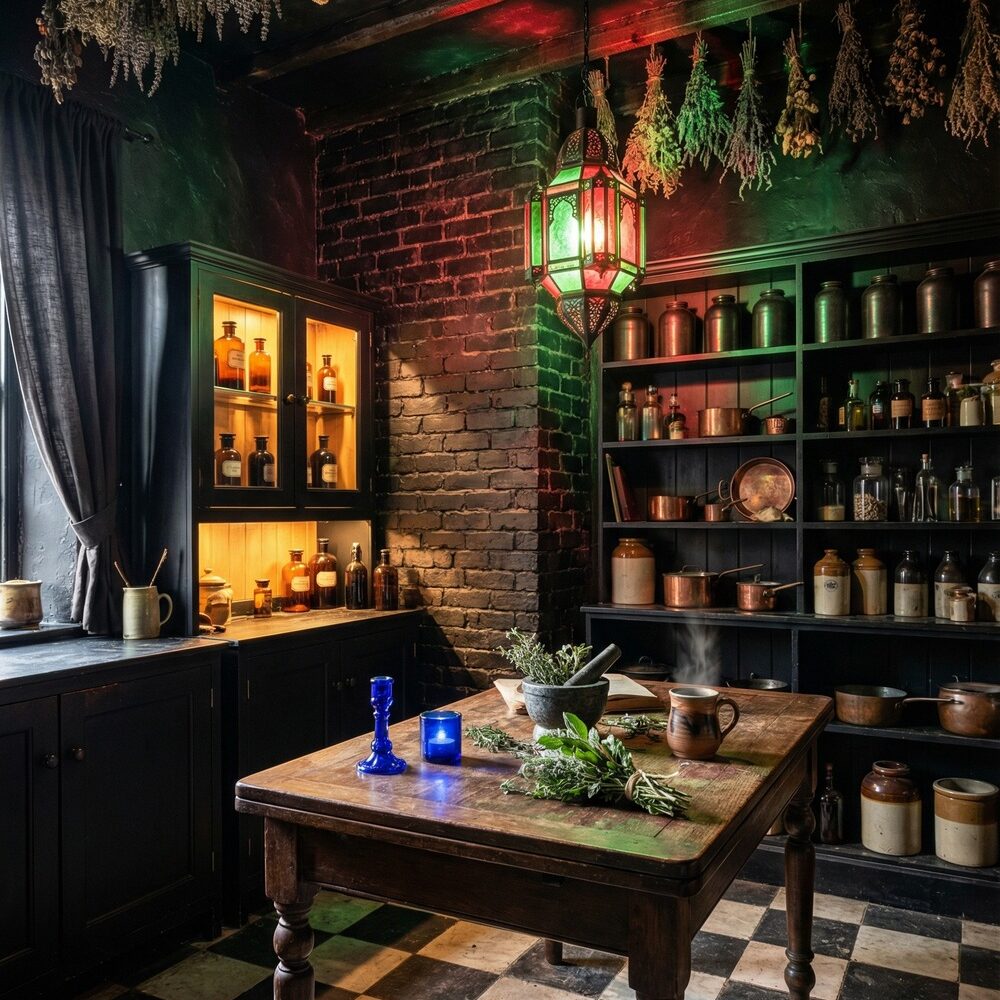
The witchcore kitchen is the most practical and most underserved room in this aesthetic. Dark cabinets — forest green, near-black, deep navy — with [brass cup pulls. Open shelves lined with glass storage jars filled with dried herbs, seeds, spices, and botanical ingredients. Copper cookware hanging from a ceiling rack. Cast iron cookware on the stove. Dried herb bundles hanging from ceiling hooks above the prep area. A [vintage kitchen scale on the counter beside the herb jars. A dark ceramic mortar and pestle used daily.
The witchcore kitchen looks the way it looks because the person who cooks in it takes ingredients seriously. The jars are full because things are being made. The copper pots have been used. The cast iron is seasoned. The herbs are fresh from somewhere and drying on the rack until they are not. This is the kitchen that belongs to someone who considers cooking a form of practice — which in a witchcore room is exactly what it is.
The Altar
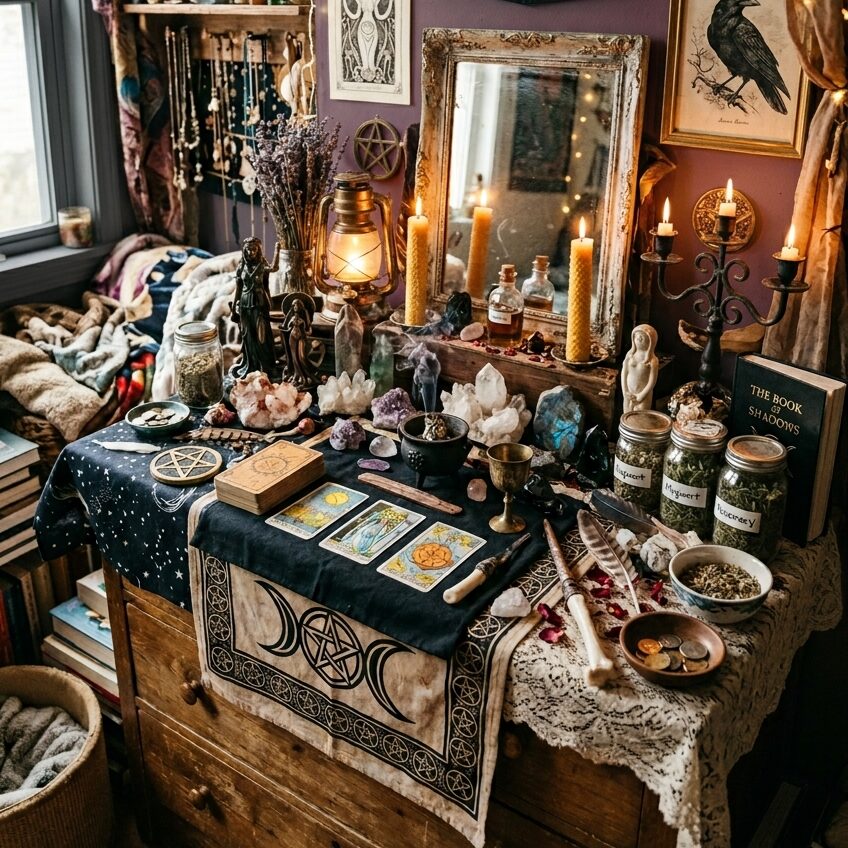
Every witchcore room has one surface that is more intentional than the others. Not the most decorated — the most considered. The altar corner is not a display. It is a working surface that happens to be beautiful because everything on it was chosen with care.
A small dark wood side table or floating corner shelf positioned in the corner of the bedroom away from the main desk. On it: a white pillar candle in a brass candle holder. A small crystal cluster. A dried rose bundle. An incense holder with a stick burned most of the way down. The tarot deck. A small ceramic bowl with a few significant stones. A handwritten note or sigil on a small piece of paper.
Nothing on the altar corner is there for appearance. Everything is there because it belongs to a practice that predates the room and will outlast any particular arrangement of it. The corner looks the way it looks because someone uses it. That is the only design principle that matters here.
How To Start
Buy the apothecary bottles first. A set of glass bottles with cork lids in three heights, mounted on a dark wood floating shelf above the desk, is the single purchase that establishes the aesthetic most immediately. Fill them with whatever you have — dried herbs from the kitchen, salt, seeds, crystals, things from outside. The shelf does not need to be complete to be right. It needs to be started.
Add the crystals second. Position them in the light — windowsill, front of the shelf, desk surface. The room begins to feel different when there are things in it that interact with light in interesting ways.
Light the candles third. Not as decoration — as practice. Leave the overhead light off after dark and navigate by lamp and candlelight for one evening. The room will tell you what it needs next.
Everything after that is accumulation. The herbs come home from a market and get hung from a hook. The tarot deck comes out of the drawer and stays on the desk. The plants grow into corners they were not invited into. The shelf fills up. The walls fill up. The room becomes what it has been trying to become since the first bottle went up on the first shelf.
That is how every witchcore room actually gets built. One object at a time, each one placed with a reason, until the room has a practice of its own.