
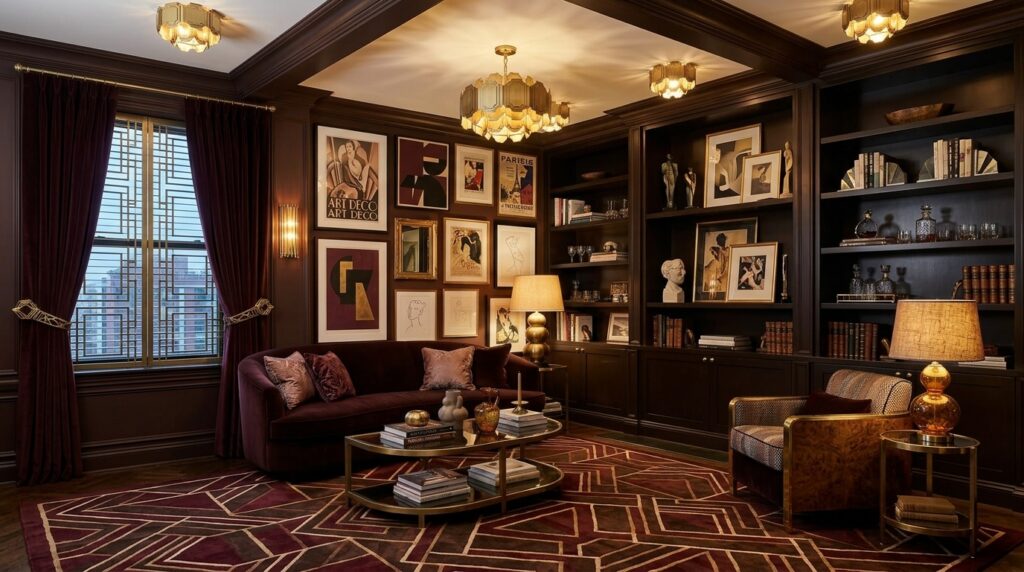
I have been thinking about what Jay Gatsby’s apartment would look like if he lived now. Not the mansion — the apartment. The one in a building with floor-to-ceiling windows and a city view and walls dark enough that the skyline at dusk looks like a painting someone commissioned specifically for this room. The furniture is velvet and curved and the coffee table is brass and glass and oval because rectangles were never the point. The walls are covered in art — vintage travel posters, geometric prints, a line drawing of a woman that looks like it came from a 1925 Paris atelier — because the person who lives here has been to places and has opinions about all of them.
Neo Deco is a sophisticated, streamlined, and moody interpretation of the Art Deco era — far more than a simple throwback to the Roaring Twenties. It represents a pivot away from stark minimalism, embracing instead a luxurious, personalized, and historically-aware aesthetic that demands glamour while remaining genuinely livable.
What distinguishes this revival from nostalgic pastiche is its restraint. Where the original Art Deco movement celebrated excess as ideology, neo deco pairs sculptural statement pieces with clean architectural lines and muted palettes — the result is an aesthetic that honours its heritage while speaking fluently to how we actually live now.
This is how to build that room. Every brass detail, every curved velvet surface, every wall covered in the art of a century that knew how to have an opinion about what a room should feel like.
The Look
Neo Deco takes the iconic elements of Art Deco and softens them for the modern home. Instead of glossy surfaces and stark contrasts, we see richer, deeper, warmer expressions of the same geometry and glamour — chocolate brown walls instead of ivory lacquer, deep burgundy velvet instead of pale silk, aged brass instead of polished chrome.
The walls are dark chocolate espresso — panelled where the architecture allows, painted everywhere else. Against them: a gallery wall of vintage travel posters and art deco prints in thin gold frames, floor to ceiling, the kind of wall that takes years to accumulate and approximately forty minutes to start. A burgundy wine velvet curved sofa — low, modern in silhouette, decidedly not from IKEA. An oval brass and glass coffee table in front of it, stacked with design books and a crystal decanter and nothing that was placed there for appearance.
Above it all: a geometric gold art deco chandelier with faceted glass panels that catch the light and scatter it across the dark walls in a way that no other fixture manages. The room feels like 1925 and 2026 simultaneously. That is the entire point.
10 Neo Deco Room Decor Ideas
1. The walls go dark and the geometry begins
People are craving warmth and personality after years of pale, ultra-minimal interiors. Darker tones make spaces feel grounding and comforting, and there is renewed interest in craft, vintage influence, and statement pieces. Neo Deco sits at this exact cultural moment — quiet luxury evolving into something more expressive, still refined but less neutral.
Deep chocolate brown, near-black charcoal, or dark moody taupe — these are the neo deco wall colours. Not the ivory and cream of classic Art Deco, which belonged to a specific moment of optimism and available wealth. The neo deco palette is more knowing than that — it has been through several decades of design trends since the 1920s and emerged with a preference for warmth over brightness and depth over polish.
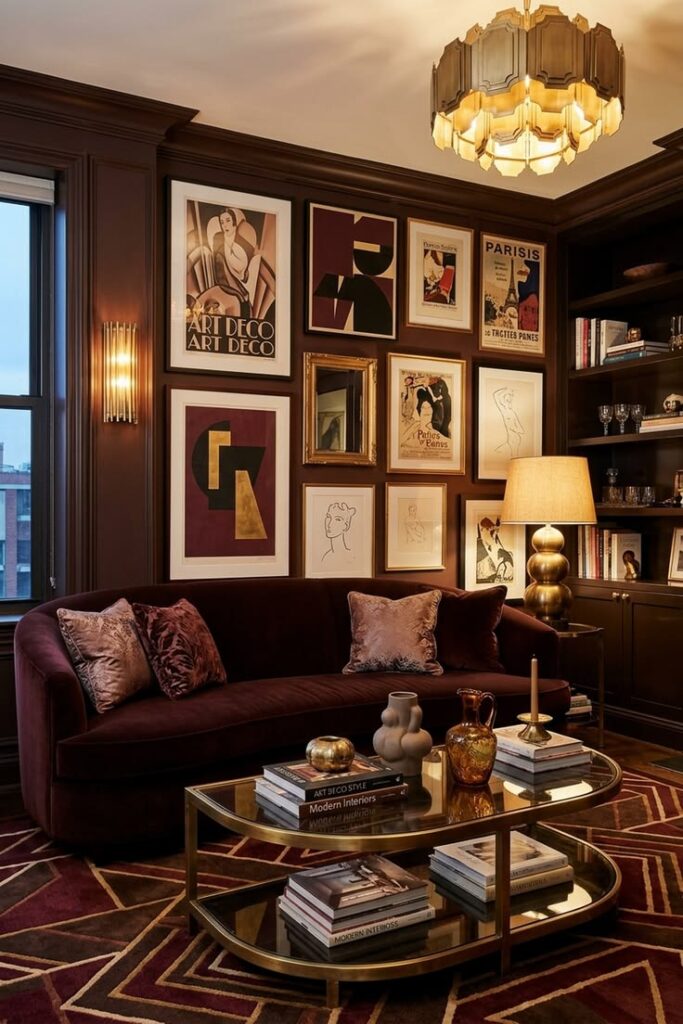
Dark chocolate or espresso brown on all four walls plus the ceiling — or at minimum the main gallery wall — changes the room completely. The gilt frames on the travel posters begin to glow. The brass coffee table reads as warm rather than shiny. The velvet sofa absorbs light and becomes the room’s centre of gravity. Everything that was merely decorative against a light wall becomes architectural against a dark one.
2. The oval brass and glass coffee table is non-negotiable
The oval brass and glass coffee table appears in every successful neo deco living room for a reason. It is the piece that solves the room’s central tension — the geometry of Art Deco requires strong shape, but the contemporary edit of neo deco requires that the shape not be heavy. An oval brass frame with a clear glass top is both visually geometric and visually light. It shows the rug beneath it. It reflects the chandelier above it. It holds a stack of design books, a crystal decanter, and a ceramic object without the whole surface looking cluttered.
Stack it correctly. Three to four design books flat on the lower shelf. On the glass surface: a crystal decanter with two crystal glasses, a small sculptural ceramic object, a brass tray with a candle. Nothing symmetrical. Nothing arranged.
3. The gallery wall is the room’s autobiography
Neo Deco’s gallery walls favour vintage travel posters from Paris, the Orient Express, and the great ocean liners of the 1920s and 30s — the art of a moment when travel felt like a grand statement and graphic design had fully understood what geometry could do. These posters are now the cultural shorthand for an entire era of sophisticated urban life.
The gallery wall in Image 1 has it exactly right. Large vintage travel poster prints in white mats and thin gold frames — Paris, Palais de Paris, the suggestion of somewhere specific and glamorous. Around them: geometric abstract prints in burgundy and black and gold, a line drawing of a woman in a style that references Tamara de Lempicka without directly reproducing her, a gilt mirror positioned asymmetrically. Nothing matches. Everything belongs to the same era.
The gallery wall is not finished when it looks full. It is finished when it looks like someone has been adding to it for years and is not done yet.
4. The velvet curved sofa defines the silhouette
Neo Deco is highly architectural — geometric patterns and symmetrical layouts create structure and formality, but the furniture silhouettes of the contemporary revival are lighter and more modern than the monumental scale of original Art Deco. The curved sofa in velvet is the perfect expression of this — it references the sweeping forms of the 1920s while fitting into a standard apartment living room without overwhelming it.
A burgundy wine velvet curved sofa — low-profile, modern in its proportions, curved rather than straight-armed — is the room’s primary statement. The curve is the neo deco detail that distinguishes it from a standard contemporary sofa. Straight arms belong to minimalism. Curved arms belong to an era that understood that furniture should have a point of view.
Layer it correctly. Dusty rose or mauve velvet cushions — not burgundy matching the sofa, a tone lighter that creates a subtle gradient. A geometric or art deco pattern throw pillow for visual variation. A cashmere or wool throw draped over one arm. The sofa should look like someone has been sitting in it having an interesting conversation.
5. The geometric gold chandelier changes everything above you
The geometric art deco chandelier with faceted gold glass panels in Image 1 is the most extraordinary lighting object in the neo deco image library. It is the chandelier that the room was built around rather than the chandelier that was added to the room after the fact — which is the distinction that separates rooms that feel designed from rooms that feel assembled.
Statement lighting is the most immediately transformative neo deco investment. Swapping out simple fixtures for sculptural pendant lamps with brass or chrome detailing and a strong geometric form changes the quality of light in the entire room and signals immediately that the space has a considered aesthetic identity.
A geometric gold art deco chandelier — faceted glass, brass frame, multi-arm configuration — positioned centre room rather than centre ceiling is the correct installation. The room’s centre of gravity is the sofa and the coffee table. The chandelier should acknowledge that. Position it to cast warm light directly on the brass coffee table surface below and watch the reflections do the rest of the work.
6. The art deco geometric rug anchors the whole composition
The art deco geometric rug — chevron patterns, stepped forms, sunburst motifs in deep jewel tones — is the surface that holds every other element in the room in relationship with each other. It is the visual grammar of the 1920s translated into the most functional object in the room.
The rug in Image 1 is deep burgundy and gold with a bold geometric pattern — large enough that the coffee table sits completely on it, large enough that the front legs of the sofa sit on it, large enough that it defines the seating area as an intentional space rather than furniture arranged on a floor.
The pattern should be bold — large-scale chevron, stepped medallion, geometric border with strong contrast. A subtle pattern disappears under the coffee table. A bold pattern reads correctly from across the room and from every photograph ever taken of the space.
7. Brass throughout — but not everywhere
Neo deco’s love of brass is specific. Unlacquered brass ages gracefully, developing a patina that deepens with use. Mix brass with matte textures rather than other metals. A brass coffee table, brass chandelier, and brass wall sconces in the same room is not too much brass if every other surface is matte velvet, dark painted wall, or glass.
The brass objects in a neo deco room are not decorative. They are structural — the frame of the coffee table, the body of the chandelier, the stem of the table lamp. The double gourd brass table lamp in Image 1 is the correct version of a table lamp for this aesthetic — sculptural, warm, specific in its reference to the 1920s without being literal about it.
Linear brass wall sconces flanking the gallery wall provide accent lighting that makes the framed prints glow without competing with the chandelier above. A brass bar cart in the corner with crystal decanters and glassware is the neo deco object that makes the room feel like somewhere that knows how to have a drink at the end of the evening. Antique bar carts are up 100% on Pinterest searches in 2026 — this is the moment to put one in the corner.
8. The vintage travel poster gallery wall — a closer look
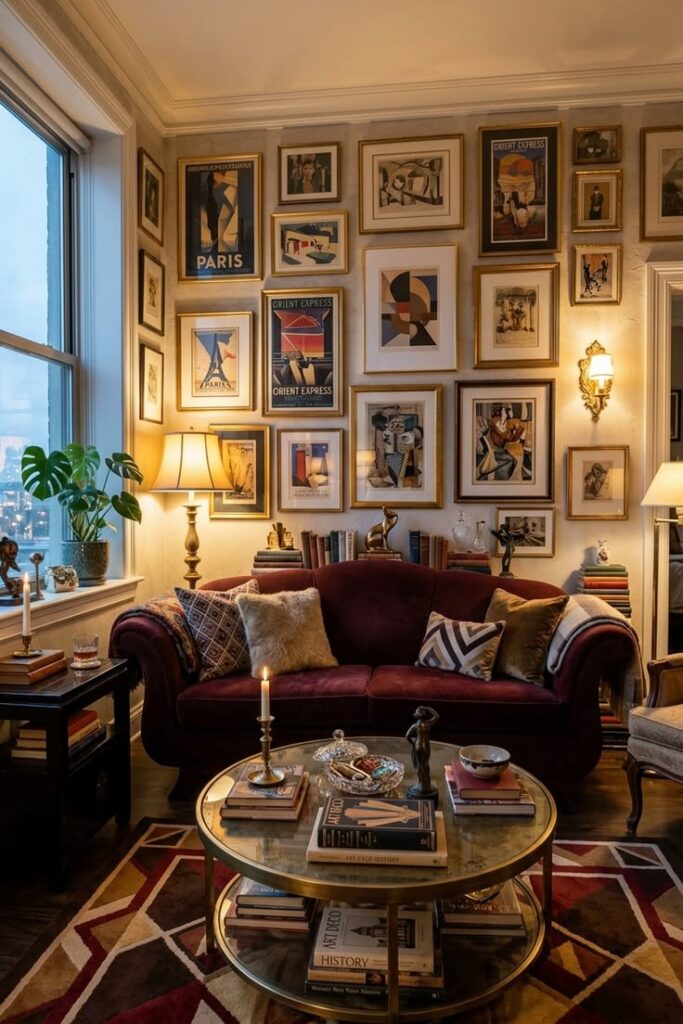
Image 2 shows the gallery wall taken to its absolute maximum — walls covered floor to ceiling with Paris travel posters, Orient Express graphics, modernist figurative prints, cubist compositions, and everything else the 1920s and 30s produced in the way of bold graphic imagery. No white space. No breathing room. Every square inch of wall doing something.
The prints available as public domain or low-cost reproduction: every major vintage travel poster from the Cassandre archive — the Normandie ocean liner, the Dubonnet series, the Nord Express — is widely reproduced and legally available as a print. The geometric abstracts of Fernand Léger and Robert Delaunay are entirely public domain. The figurative drawings in the style of Tamara de Lempicka — sleek, geometric, Art Deco portraiture — are available as reproduction prints. None of this requires original art. It requires good frames, a willingness to commit to wall coverage, and an understanding that the gallery wall is not finished when it looks full.
9. The neo deco bedroom — where the Great Gatsby keeps his books
The bedroom version of neo deco is the room’s more intimate register. Same dark chocolate brown walls. Same geometric gold frames on the gallery wall. But the bed is the room’s anchor rather than the sofa, and the art shifts from vintage travel posters to art deco geometric abstracts and figurative prints in a tighter, more disciplined arrangement.
A curved burgundy velvet bed frame with a high upholstered headboard — the same curved silhouette as the sofa, translated into the bedroom’s primary object. A geometric sunburst brass mirror on the wall beside the window — the neo deco mirror that makes the room feel like it has a second window where there is actually only a reflection. A sculptural double gourd brass table lamp on a black lacquered nightstand.
On the bedside tray: The Great Gatsby. Tender is the Night. Any Fitzgerald novel that has been read enough times to have opinions about it. The bedroom in the image has The Great Gatsby on the brass tray because whoever built that room understood that neo deco is a literary as much as a visual aesthetic — the 1920s produced both the art and the literature simultaneously and the bedroom should acknowledge both.
A bold art deco geometric rug in cream and rust and gold — large enough to extend past the foot of the bed on both sides. Champagne or gold velvet curtains floor to ceiling, touching the floor. A dark wood etagere bookshelf with a crystal decanter and whiskey glasses, a small brass clock, stacked art books, a ceramic object.
10. The coffee table books are not decorative
The coffee table in a neo deco room has books on it that have been read. Art Deco Style. Modern Interiors. The Great Houses. Anything with a spine that signals a specific interest in the visual culture of a specific era. These are not coffee table books purchased because the cover colour matched the room — they are books about things the person who lives here cares about, stacked on the brass and glass table because the bookshelf ran out of space and the coffee table was the next available surface.
Stack them correctly. Four or five books flat, not standing. Largest at the bottom, smallest at the top. A small brass geometric sculpture on top of the stack. A crystal glass on the table surface beside it. The table should look like someone was just sitting in front of it.
The Art on the Walls: The Visual Culture of the 1920s
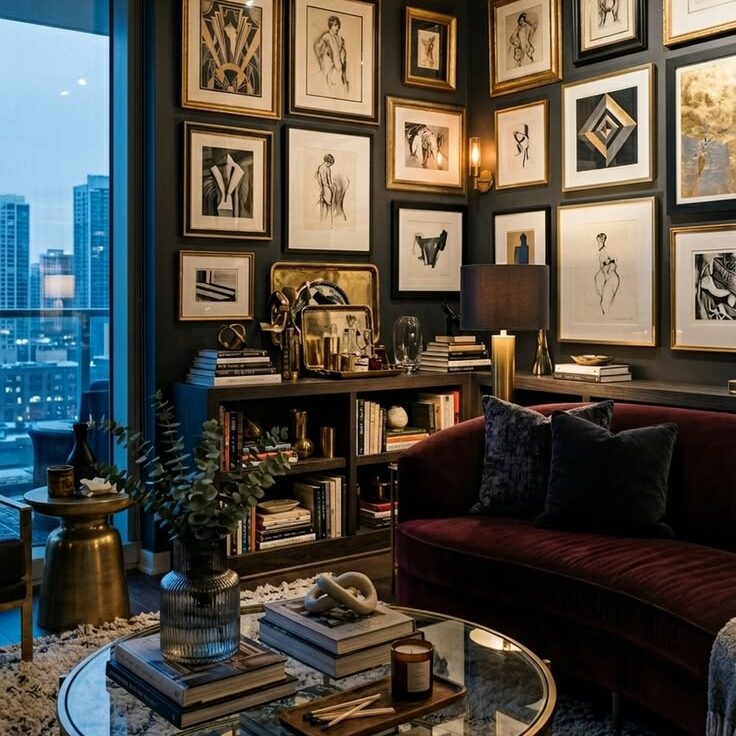
The gallery wall in a neo deco room has a specific art historical source — the visual culture of Paris and New York between 1920 and 1939. This is one of the most extensively documented and freely reproduced periods in design history, which means the art is both culturally correct and practically accessible.
The vintage travel posters — Cassandre’s Normandie poster, the Orient Express graphics, the Paris tourist office series — are the most immediately recognisable neo deco wall objects. The graphic design of the 1920s travel industry understood geometry and colour in a way that translated perfectly to large-format poster art. These are widely available as high-quality reproduction prints and sit in thin gold frames at any size.
Tamara de Lempicka painted the women of the 1920s European elite with a geometric precision that made every portrait look like the subject was made of polished surfaces. Her work is extensively reproduced and reproduction print sellers carry the major works at low cost. A large de Lempicka-style portrait in a gold frame above the sofa is the most explicitly 1920s element a neo deco gallery wall can have.
The geometric abstracts — Fernand Léger, Robert Delaunay, and the broader Cubist-informed design of the period — are entirely public domain and available as high-resolution downloads. Printed at 20×24 and framed in thin gold, they give the gallery wall its modernist edge alongside the figurative and decorative elements.
The gallery wall should feel like it was assembled by someone who spent time in museums in Paris and came home with prints and opinions. That is the only brief it needs.
How To Start
Buy the oval brass and glass coffee table first. It is the object that most immediately establishes the room’s aesthetic identity before a single wall is painted or a single frame is hung. Set it in front of whatever sofa currently exists. Stack three books on it. Put a crystal glass on the surface. The room already looks like it is becoming something specific.
Paint the walls second. Dark chocolate brown or deep charcoal. The coffee table you already placed will look completely different against a dark wall than it did against whatever was there before.
Build the gallery wall third. Start with one large vintage travel poster in a thin gold frame. Hang it centre wall. Everything else grows around it as the right prints come along. The gallery wall that looks accumulated over years looks that way because it was — but it starts with one frame and one afternoon.
The chandelier, the velvet sofa, the art deco rug — these are the statement purchases that complete the room. They come when the room has earned them, which it will.